
Auto-Margin Replenishment (AMR) is a risk management feature available in Isolated Margin mode that automatically adds margin to a position using your available account balance to help reduce liquidation risk. You can enable or disable AMR at any time from the Position panel.
When AMR is enabled, the system automatically transfers available funds from your Unified Trading Account (UTA) to the position when the margin level approaches the liquidation threshold. This helps reduce the effective leverage and moves the liquidation price further away from the mark price.
When the margin level approaches the liquidation threshold:
AMR is currently supported for the following products:
- USDT Perpetual
- USDT Expiry
- USDC Perpetual
Notes:
-Effective leverage is not displayed on the trading interface. However, you can calculate it using the formula: Position Value ÷ Initial Margin.
-AMR helps reduce liquidation risk but does not guarantee that liquidation will not occur. If market volatility is high or your available balance is insufficient, liquidation may still occur.
- When AMR is enabled, the system will continue adding margin to your position to reduce effective leverage. The lowest leverage your position can reach is 1×, meaning your initial margin equals your position value and the position is fully covered. Once your position reaches 1× leverage, no additional margin will be added, even if you still have an available balance.
Scenario 1:
Assume Trader A holds a BTCUSDT long position and has enabled AMR.
- Available balance in the UTA: 6,000 USDT
- Position value: 40,000 USDT
- Initial margin: 4,000 USDT
- Actual leverage: 10x
- Effective leverage: 10x
- Liquidation price: 7,240 USDT
If the market moves against the position and the mark price reaches 7,240 USDT, AMR will be triggered, and the position will change as follows:
- Available balance in the UTA: 6,000 USDT → 2,000 USDT (4,000 USDT added to initial margin)
- Position value: 40,000 USDT (unchanged)
- Initial margin: 4,000 USDT → 8,000 USDT (+4,000 USDT from available balance)
- Actual leverage: 10x (unchanged)
- Effective leverage: 10x → 5x
- Est. liquidation price: 7,240 USDT → 6,040 USDT
If the market continues to move against the position and the mark price reaches 6,040 USDT, AMR will be triggered a second time, with the following changes:
- Available balance in the UTA: 2,000 USDT → 0 USDT (2,000 USDT added to initial margin)
- Position value: 40,000 USDT (unchanged)
- Initial margin: 8,000 USDT → 10,000 USDT (+2,000 USDT from available balance)
- Actual leverage: 10x (unchanged)
- Effective leverage: 5x → 4x
- Est. liquidation price: 6,040 USDT → 6,440 USDT
However, since there is no available balance left in the account, if the mark price reaches 6,440 USDT, the position will be liquidated, as AMR can no longer add margin to the position.
Scenario 2:
Assume Trader B holds an ETHUSDC short position and has enabled AMR.
- Available balance in the UTA: 10,000 USDC
- Position value: 1,000 USDC
- Initial margin: 500 USDC
- Actual leverage: 2x
- Effective leverage: 2x
- Liquidation Price: 2,500 USDC
If the market moves against the position and the mark price reaches 2,500 USDC, AMR will be triggered, and the position will change as follows:
- Available balance in the UTA: 10,000 USDC → 9,500 USDC (500 USDC added to initial margin)
- Position value: 1,000 USDC (unchanged)
- Initial margin: 500 USDC → 1,000 USDC (+500 USDC from available balance)
- Actual leverage: 2x (unchanged)
- Effective leverage: 2x → 1x
- Liquidation price: 2,500 USDC → 2,700 USDC
If the market continues to move against the position and the mark price reaches 2,700 USDC, AMR will not be triggered again, as the initial margin has reached the level corresponding to 1× leverage (i.e., the initial margin equals the position value). The position will then be liquidated, as AMR can no longer add margin.
Notes:
- Calculations in the example above do not include trading fees.
- When liquidation is triggered, the system will first cancel any unfilled active orders to free up additional margin in an attempt to avoid liquidation.
- You will receive notifications when AMR is triggered, giving you more time to manage your position.
How to Enable or Disable AMR
On the website:
Go to the Trading page, locate your position in the Positions tab under the chart, and toggle the Auto-Margin Replenishment switch to enable or disable it.

On the app:
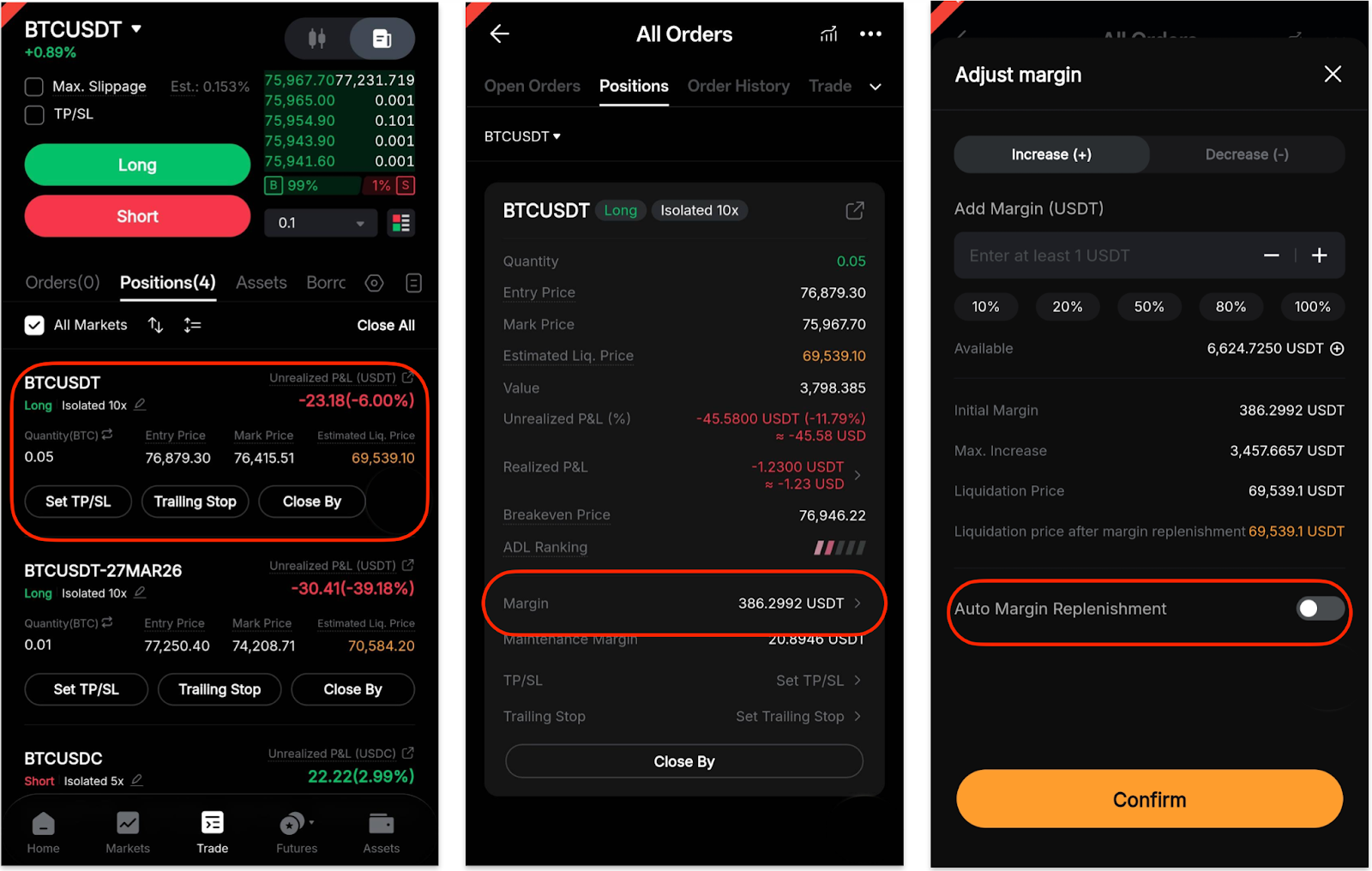
Go to Trade, locate your position in the Positions tab under the order placement zone, tap the position, then tap Margin, and toggle the Auto-Margin Replenishment switch to enable or disable it.
Notes:
- AMR is only available in Isolated Margin mode and is supported for USDT Perpetual, USDT Expiry, and USDC Perpetual contracts. Inverse Perpetual and Expiry contracts are not supported.
- Under Isolated Margin mode, long and short positions are independent and can be liquidated separately.