
What is unrealized P&L?
Unrealized P&L is a real-time estimate of your position's profit or loss based on the last traded price or current market price.
What is realized P&L?
Realized P&L reflects the actual profit or loss recorded in your account, taking into account trading and funding fees (if applicable), as well as any profit or loss from closed positions.
What is Return on Investment (ROI)?
ROI (%) represents your profit or loss as a percentage of the margin used to open the position.
What is the difference between last traded price (LTP) and mark price?
- Last traded price (LTP) refers to the most recently executed price on the trading platform and is typically used to display unrealized P&L.
- Mark price is a fair price calculated based on the underlying index price and funding rate mechanism. It is used to trigger liquidations and is designed to reduce the impact of market manipulation and extreme price volatility.
How is P&L calculated for USDT and USDC contracts?
For USDT and USDC Perpetual Contracts, P&L is settled in USDT or USDC, respectively, and follows a linear calculation model where P&L changes proportionally with price movement.
- Long position: Quantity × (Exit price − Entry price)
- Short position: Quantity × (Entry price − Exit price)
Note: While the formula is the same for both USDT and USDC contracts, USDC contracts feature a settlement mechanism where realized P&L is periodically settled to your account balance.
How is P&L calculated for Inverse Contracts?
Inverse Contracts are settled in the underlying cryptocurrency (e.g., BTC, ETH) rather than a stablecoin. Since both the contract value and settlement currency are denominated in the underlying asset, P&L is calculated using reciprocal prices.
- Long position: Quantity × [(1 ÷ Entry price) − (1 ÷ Exit price)]
- Short position: Quantity × [(1 ÷ Exit price) − (1 ÷ Entry price)]
Does leverage affect my actual unrealized P&L?
No. Leverage does not change your actual profit or loss.
Your unrealized P&L is determined by your position size, entry price, and current or exit price. Leverage only affects the amount of initial margin required to open the position.
In other words, higher leverage allows you to open the same position with less margin, but it does not increase the actual P&L generated by that position.
Does leverage affect my ROI (%)?
Yes. ROI (%) is calculated by dividing your unrealized P&L by the initial margin.
When leverage is higher, the required initial margin is lower, resulting in a higher ROI (%). Conversely, when leverage is lower, the required initial margin is higher, resulting in a lower ROI (%).
Note: Adjusting leverage affects ROI (%) but not your actual profit or loss.
Formula:
ROI (%) = Unrealized P&L / Initial Margin x 100
Example 1 (USDT Perpetual Contract)
Contract Pair: BTCUSDT
Position Size: 0.1
Direction: Long
Leverage: 10x
Average Entry Price: 70,000
Current Last Traded Price: 75,000
Initial Margin = (70,000 x 0.1) / 10 = 700 USDT
Unrealized Position P&L (excluding fees) = 0.1 x (75,000 − 70,000) = 500 USDT
ROI% = (500 / 700) x 100 = 71.43%
Now, assuming the leverage used is increased to 20x
New initial margin = (70,000 x 0.1) / 20 = 350 USDT
ROI = (500 / 350) x 100 = 142.85%
ROI (%) has increased from 71.43% to 142.85%
Example 2 (Inverse Perpetual Contract)
Contract Pair: BTCUSD
Position Size: 1000
Direction: Long
Leverage: 10x
Average Entry Price: 6,800
Current Last Traded Price: 7,000
Initial Margin = 1,000 / (6,800 × 10) = 0.01470588 BTC
Unrealized Position P&L (excluding fees) = 1,000 x [(1 / 6,800) − (1 / 7,000)] = 0.00420168 BTC
ROI% = (0.00420168 / 00.01470588) x 100 = 28.5714%
Now, assuming the leverage used is increased to 20x
New initial margin = 1,000 / (6,800 × 20) = 0.00735294 BTC
ROI =: (0.00420168 / 0.00735294) x 100 = 57.1429%
ROI (%) has increased from 28.5714% to 57.1429%
Notice that in the two examples above, even after applying higher leverage, the only variable that has changed is the position margin (denominator), thereby resulting in the increase of ROI. However, the P&L will remain constant if the trader closes the position. In other words, the change in leverage will affect the initial margin required but the profit and loss will still be the same regardless whether the leverage used is 10x or 20x.
How can I increase my actual profit amount?
To increase your actual profit, you need either:
- a larger position size, or
- a greater price difference between your entry and exit prices
Leverage alone does not increase the absolute P&L of a trade.
When exactly am I charged a funding fee?
You will only pay or receive a funding fee if you still hold the position at the exact funding time.
For example, if the funding countdown reaches 00:00:00 and your position is still open at that moment, the funding fee will apply. If you close the position before that time, no funding fee will be charged for that cycle.
For more details, please refer to Funding Fee Calculation.
What is the "Fee to Close" and why is it reserved?
The "Fee to Close" is a margin buffer reserved by the system to cover the estimated cost of closing your position in a worst-case scenario, such as liquidation. It is not necessarily the final fee you will pay.
Why is the order cost different for Buy Long and Sell Short orders?
Even when the order quantity and leverage are the same, the order cost may differ between long and short positions for two main reasons:
1. Different bankruptcy price assumptions
The system uses different bankruptcy price calculations for long and short positions, which affect the reserved Fee to Close.
2. Different fee calculation basis
For some orders, especially limit orders placed away from the current market price, the system may use a different reference price to estimate the opening fee.
As a result, the displayed order cost may differ for Buy Long and Sell Short orders.
What is the breakeven price?
The breakeven price is the price at which you can close your position without incurring a net loss, after accounting for all trading fees (both opening and closing).
How to find the breakeven price on the Bybit Kazakhstan App
Go to the Positions tab on the trading page, and tap your open position to view more details.
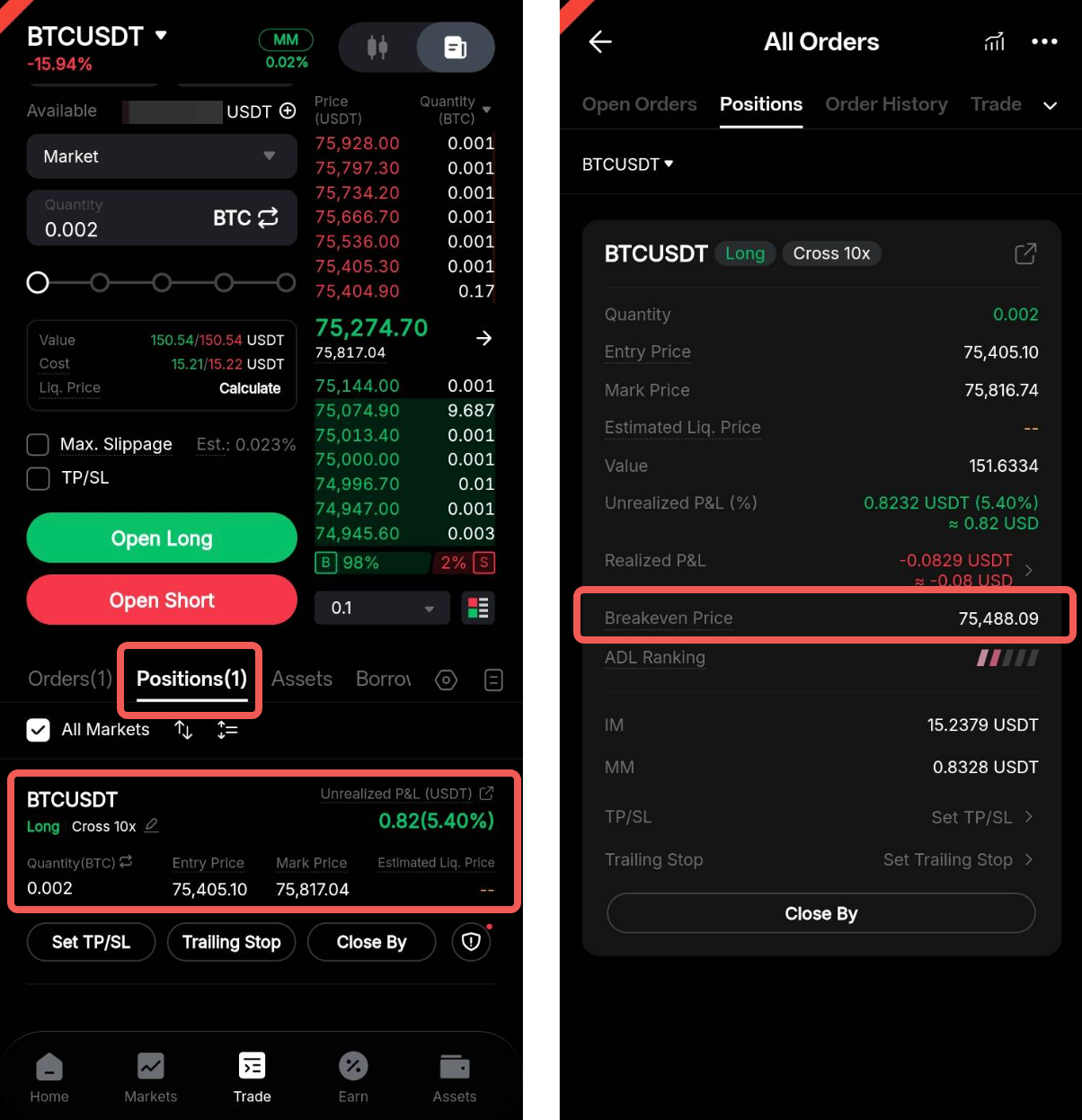
How to find the breakeven price on the website
The breakeven price is typically displayed directly under the Positions tab.

Why is my closed P&L a loss when my unrealized profit was positive?
This usually occurs because unrealized P&L is only an estimate and does not include all trading costs.
Unrealized P&L primarily reflects the price difference based on the current market price. In contrast, closed P&L reflects the final result after all fees and realized costs are included, such as:
- Opening fees
- Closing fees
- Funding fees
If your total fees exceed your trading profits, your final closed P&L may be negative, even if your unrealized P&L was positive before closing.
Why is my closed P&L different from my position P&L?
A difference between position P&L and closed P&L is normal. This is usually caused by the following factors:
1. Fees are included in the closed P&L
The P&L shown while a position is open is typically an estimate and may not include all costs. Closed P&L reflects the final result after all fees are accounted for, including trading fees and funding fees.
2. Different price references may be used
By default, P&L is typically displayed based on the last traded price (LTP). However, if the display is switched to mark price on the app, the P&L shown may differ.
LTP reflects the most recent transaction price on the platform, while the mark price is a fair reference price used primarily for liquidation purposes.
If your P&L is currently displayed based on mark price in the app, tap the Unrealized P&L area in the Positions section. This may switch the display basis or open the settings menu, where you can select LTP again.
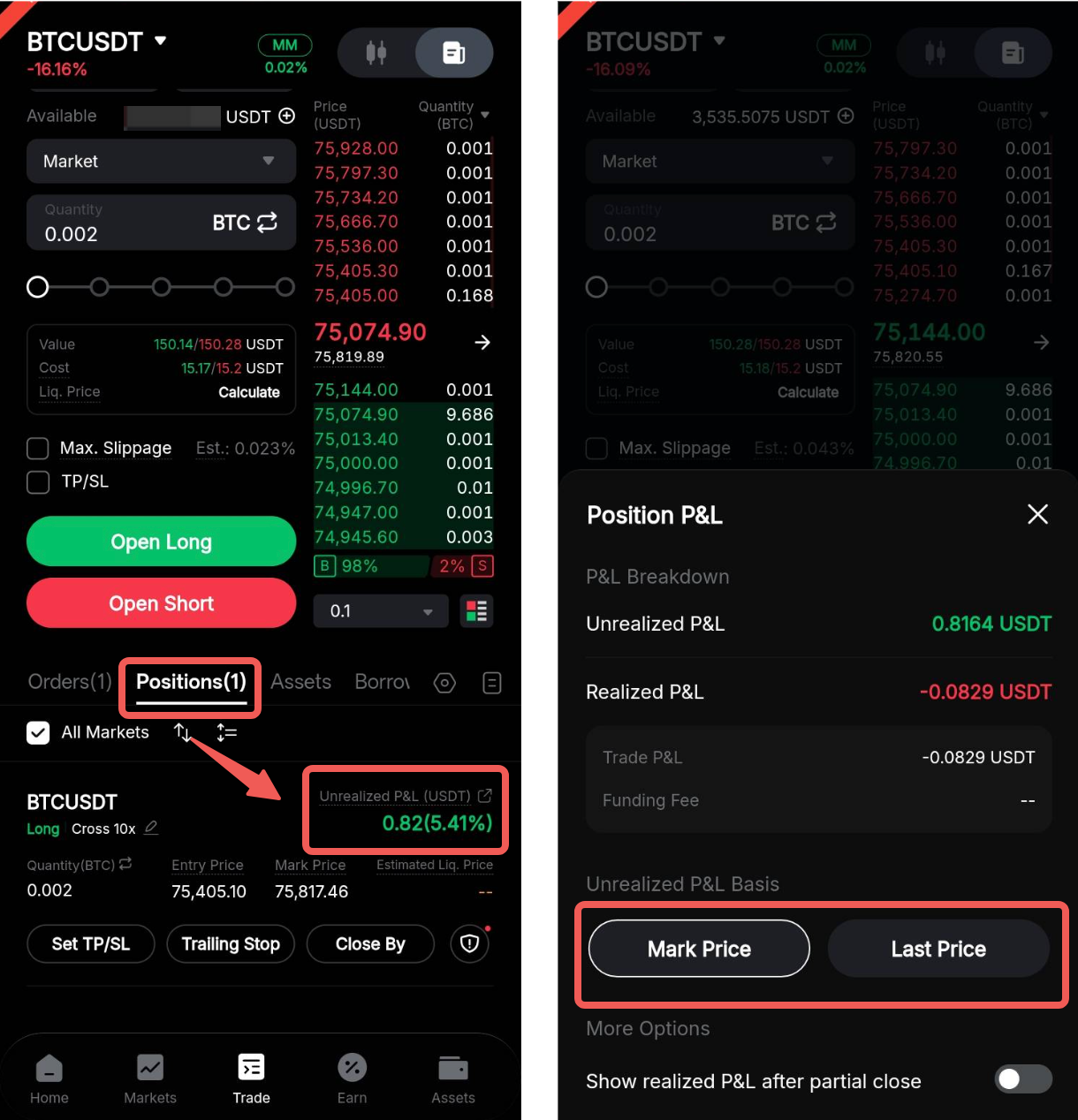
How is P&L displayed on the website?
On the website, both the Mark Price and Unrealized P&L are displayed in the Positions section at the bottom of the trading page.
By default, the unrealized P&L is calculated based on the last traded price (LTP). You can hover over the Unrealized P&L field to view the value calculated using the Mark Price, which serves as the system's fair price reference for liquidation.
