James
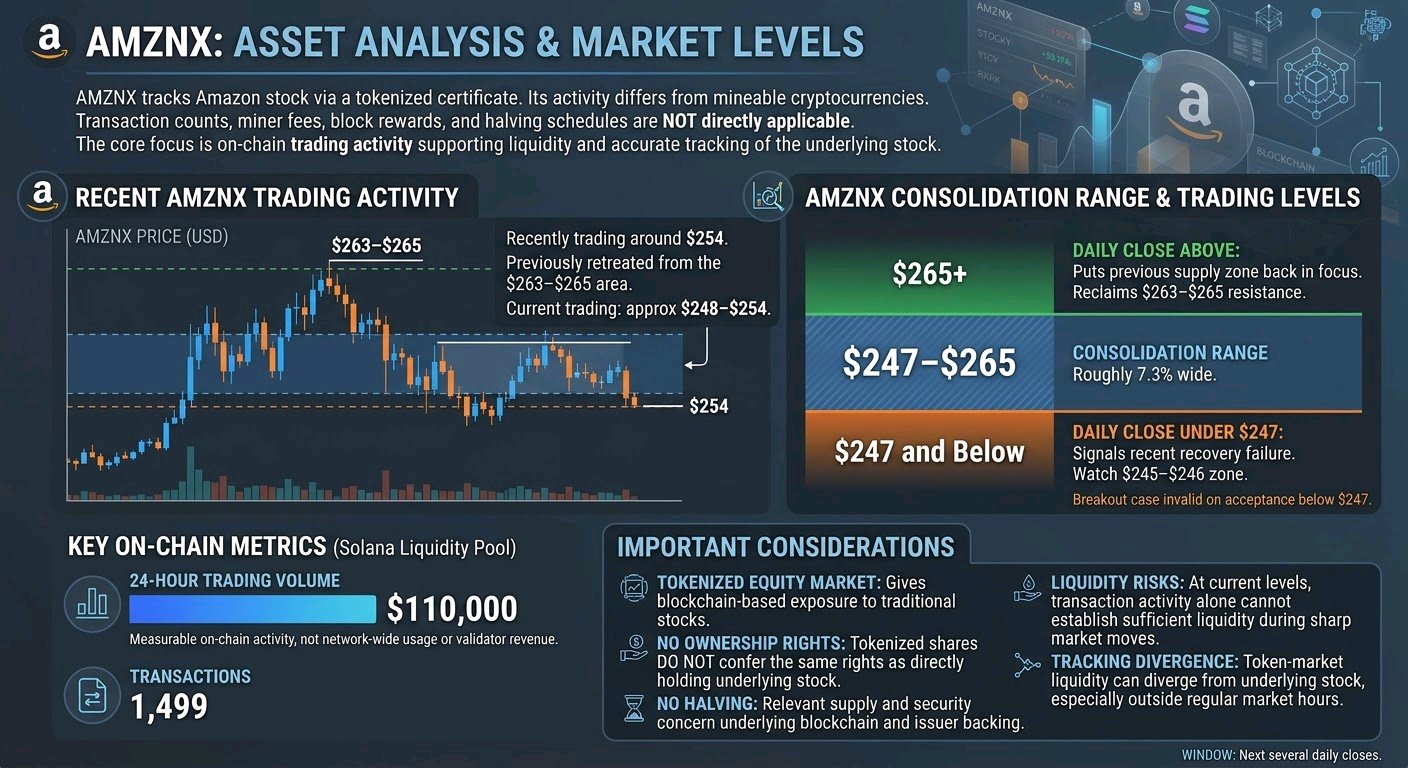
$AMZNXUSDT is a different kind of asset: it tracks Amazon stock through a tokenized certificate, so its activity needs to be read differently from a mineable cryptocurrency. Transaction counts, miner fees, block rewards and a halving schedule do not apply directly to AMZNX. The relevant question is whether on-chain trading activity supports liquidity while the token continues to track its underlying stock. AMZNX has traded around $254 recently, with the token tracking Amazon's underlying share price. On one tracked Solana liquidity pool, recent data shows roughly 1,499 transactions and about $110,000 in 24-hour trading volume. That is measurable on-chain activity, but it is not the same as network-wide usage or revenue paid to validators. AMZNX is a tokenized stock, and that is the point. Its value comes from exposure to Amazon shares, not mining rewards or a native block-reward schedule. Solana's validator economics secure the underlying blockchain, while AMZNX holders remain exposed to token liquidity, tracking differences and issuer-related risks. There is no AMZNX halving to circle on the calendar. The relevant supply and security questions concern the underlying blockchain and the token issuer's backing arrangements. At current trading levels, transaction activity alone cannot establish whether the token's liquidity is sufficient during a sharp market move. I don't think that's a design flaw. When someone quotes the transaction count, the number that pays for security is a different one. AMZNX has recently traded around $248–$254 after retreating from the $263–$265 area. Underneath is the broader tokenized-equity market, which gives eligible users blockchain-based exposure to traditional stocks. AMZNX is designed to track Amazon, but tokenized shares do not confer the same ownership rights as directly holding the underlying stock. That explains the attention, not a dated price trigger. No directional call from the middle of a box after a move this size. Levels instead: Above $265: a daily close over it puts the previous supply zone back in focus. The $263–$265 area is the first resistance region to reclaim. Below $247: a daily close under it signals that the recent recovery is failing. The $245–$246 area is the next zone to watch. $247–$265: consolidation, roughly 7.3% wide. Window: the next several daily closes. AMZNX tracks Amazon's share price, but its token-market liquidity can diverge from the underlying stock, particularly outside regular market hours. The breakout case is invalid on acceptance below $247.#ByXIMPACT
$TRUMPUSDT is a Solana-based meme token, so the security budget is paid through SOL staking economics rather than TRUMP transaction fees. The key distinction is that activity around the token does not translate directly into revenue for the underlying network's validators. So the payments usage is real, and it barely touches the security budget. TRUMP is cheap to use, with Solana’s average transaction fee around $0.008 in Q1 2026, and that is the point. But it also means the people securing the network are paid substantially through staking issuance, not fees alone. Solana’s security metric is validator stake, not hashrate, and there is no TRUMP-specific halving. The date I keep circling is November 18, 2026. Token-unlock trackers estimate roughly 28.7 million TRUMP tokens are scheduled for release, around 2.9% of total supply. That is a supply event, not a mining reward reduction. At current fee levels, token trading activity cannot replace the economic impact of additional circulating supply. I don’t think that’s a design flaw. When someone quotes the transaction count, the number that pays for security is a different one. TRUMPUSDT is trading around $1.70, down roughly 4.5% in a week, and has stalled inside a box: swing low near $1.62, high near $1.92. Underneath is the continuing token-unlock schedule, with the next major release approaching in November. It creates a potential supply overhang, so it explains the attention, not a dated price trigger. No directional call from the middle of a box after a move this size. Levels instead: Above $1.92: a daily close over it turns the old ceiling into a support test. Prior supply needs to be established from the next confirmed resistance zone. Below $1.62: a daily close under it says the breakout is failing. The next lower support needs confirmation from the chart. $1.62–$1.92: chop, roughly 18.5% wide. Window: the next several daily closes. TRUMP tends to amplify broader crypto sentiment, so a BTC range break can reset this read early. The breakout case is invalid on acceptance below $1.62. #ByXIMPACT

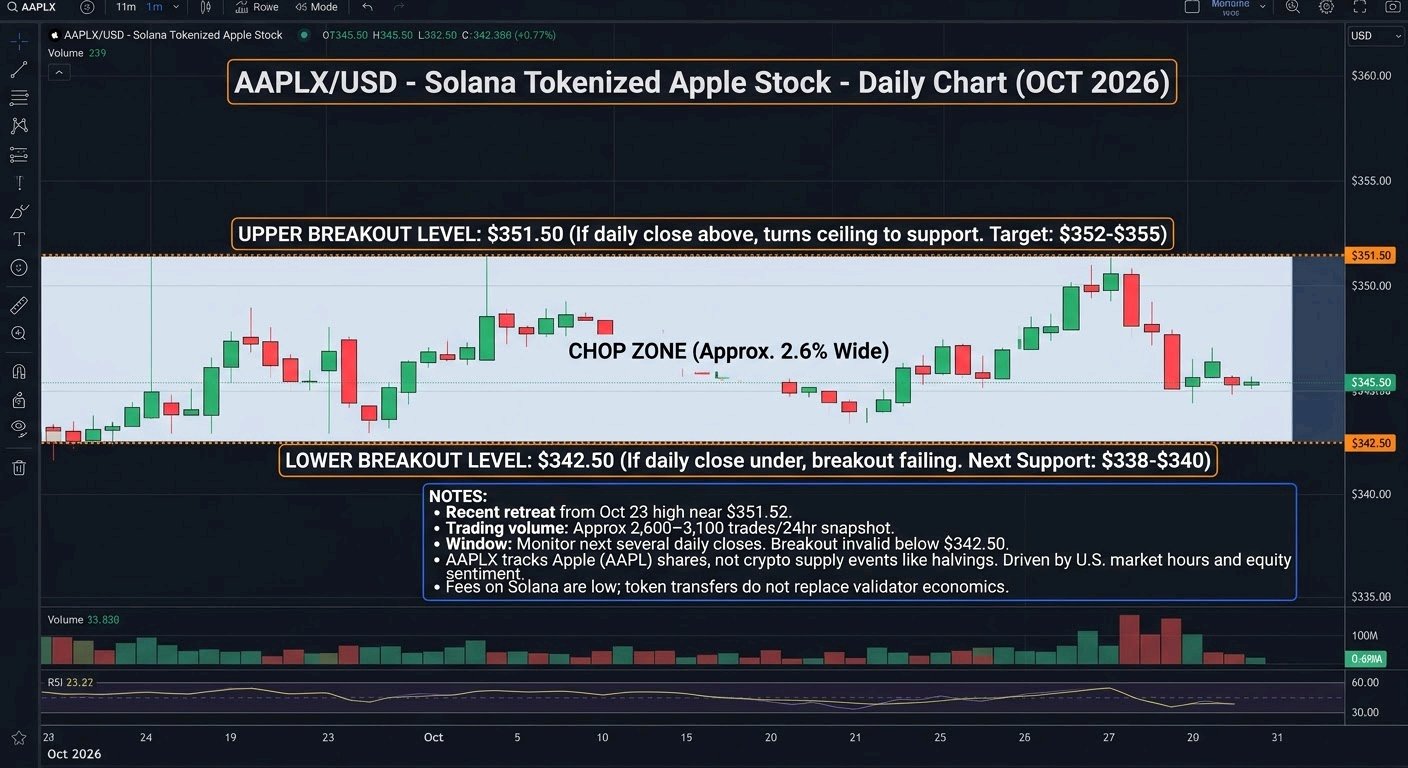
$AAPLXUSDT recorded roughly 2,600–3,100 trades across tracked markets in the latest available 24-hour snapshots, with its price near $344–$347. Median transaction size is not consistently reported across venues, and token-level fees and network security payments are not separately published. So the payments usage is real, and it barely touches the security budget. AAPLX is a tokenized Apple stock product, with transaction costs determined by the underlying blockchain and trading venue, and that is the point. There is no AAPLX-specific hashrate or miner-reward schedule. Solana validators secure the network, while AAPLX supply follows issuance and redemption rather than a fixed mining reward. The date I keep circling is the next major supply event. AAPLX has no scheduled halving, and there is no protocol-defined block reward to cut from an old amount to a new one. At current fee levels, token transfers do not replace validator economics. The relevant variables are the underlying Apple share price, token issuance and redemption, and the cost of using the network. I don’t think that’s a design flaw. When someone quotes the transaction count, the number that pays for security is a different one. AAPLX is trading around $344–$347 after retreating from its October 23 high near $351.52. Underneath is the continued demand for tokenized equities and exposure to Apple through blockchain-based products. The token tracks the underlying stock, so U.S. market hours, Apple-specific developments and broader equity sentiment explain the attention, not a dated crypto supply trigger. No directional call from the middle of a box after a move this size. Levels instead: Above $351.50: a daily close over it turns the old ceiling into a support test. Prior supply sits around $352–$355. Below $342.50: a daily close under it says the breakout is failing. Former support around $338–$340 is the next area. $342.50–$351.50: chop, roughly 2.6% wide. Window: the next several daily closes. AAPLX tends to track Apple shares more closely than broad crypto-market moves, so a sharp move in the underlying stock can reset this read early. The breakout case is invalid on acceptance below $342.50. #ByXIMPACT
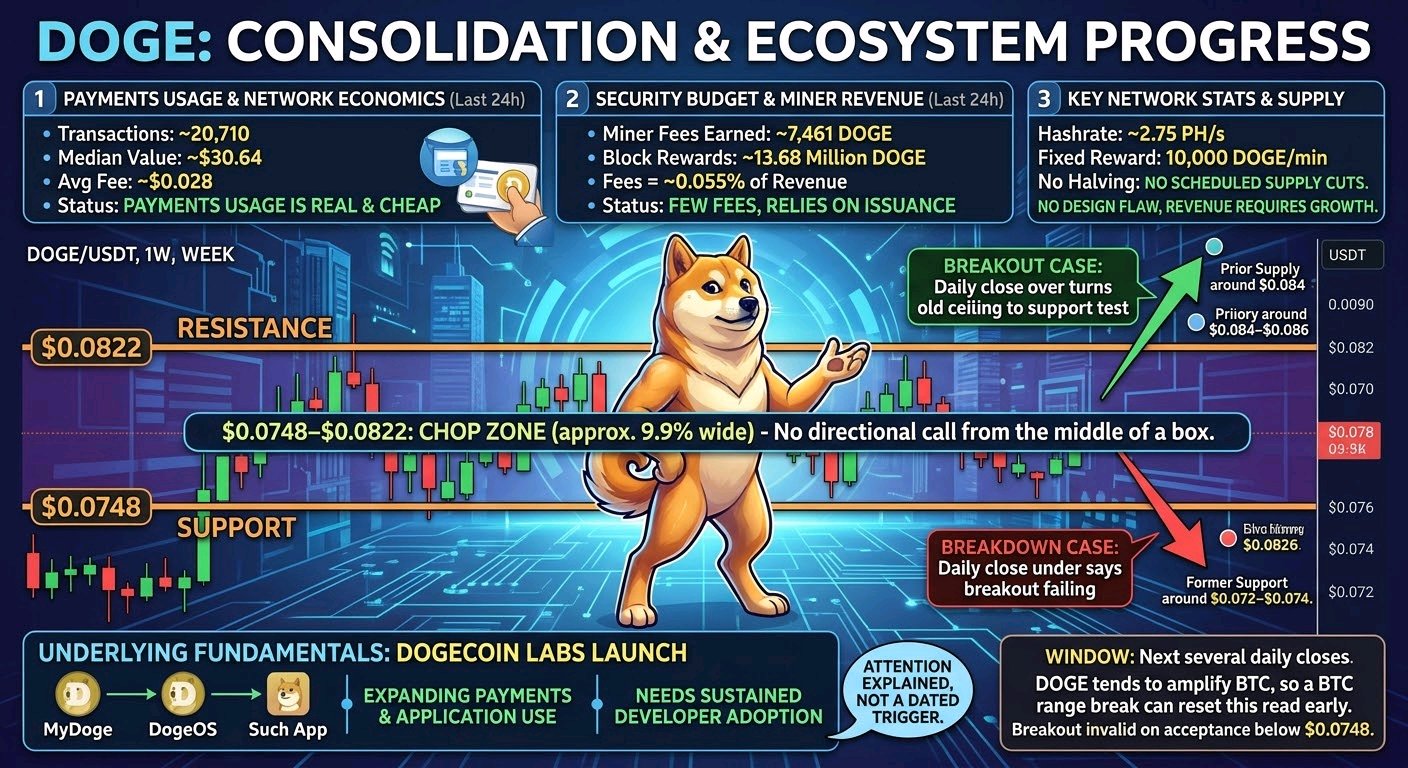
$DOGEUSDT Dogecoin moved about 20,710 transactions in the last 24 hours, with a median transaction value near $30.64. Miners earned roughly 7,461 DOGE in fees that day against about 13.68 million DOGE in block rewards. Fees were approximately 0.055% of their revenue. So the payments usage is real, and it barely touches the security budget. DOGE is cheap to use, with an average transaction fee around $0.028, and that is the point. But it also means the people running the network are paid almost entirely by issuance. Hashrate sits around 2.75 PH/s now, reflecting the computational work securing the network. The date I keep circling is different for Dogecoin: there is no scheduled halving. The block reward remains 10,000 DOGE, with new coins issued roughly every minute. At current fee levels, payments contribute very little toward miner revenue. There is no scheduled supply cut to replace, but fees would still need to grow substantially to become a more meaningful part of the security budget. I don’t think that’s a design flaw. When someone quotes the transaction count, the number that pays for security is a different one. DOGEUSDT is down roughly 2.7% over a week and has stalled inside a box: swing low near $0.0748, high near $0.0822. Underneath is the Dogecoin Labs launch, bringing MyDoge, DogeOS and Such App under one development organization to expand payments and application use. The ecosystem still needs sustained developer adoption and real user activity, so it explains the attention, not a dated trigger. No directional call from the middle of a box after a move this size. Levels instead: Above $0.0822: a daily close over it turns the old ceiling into a support test. Prior supply sits around $0.084–$0.086. Below $0.0748: a daily close under it says the breakout is failing. Former support around $0.072–$0.074 is the next area. $0.0748–$0.0822: chop, roughly 9.9% wide. Window: the next several daily closes. DOGE tends to amplify BTC, so a BTC range break can reset this read early. The breakout case is invalid on acceptance below $0.0748. #ByXIMPACT
$MNTUSDT recorded about 55,860 transactions on Mantle in the last 24 hours, with average network fees around $132. The chain generated roughly $132 in revenue that day, but transaction-level median size and a comparable validator-reward figure are not available in the same data snapshot. So the payments usage is real, and it barely touches the security budget. is cheap to use, with network fees averaging only a few fractions of a cent per transaction, and that is the point. But it also means direct chain fees alone are a small part of the economic picture supporting the network. Mantle uses Ethereum for settlement and security rather than relying on its own proof-of-work hashrate. Mantle recorded about 55,860 transactions in the last 24 hours, with a median transaction size not available in the latest public snapshot. Chain fees and revenue were roughly $144 that day, but a comparable validator-reward figure is not available to calculate fees as a percentage of security revenue. So the payments usage is real, and it barely touches the security budget. is cheap to use, with average network fees around $0.003 per transaction, and that is the point. But it also means direct fees are only a small part of the economic picture, while Ethereum settlement and security remain central to Mantle’s design. Mantle does not have its own proof-of-work hashrate; its security model relies on Ethereum settlement and the rollup’s verification mechanisms. The date I keep circling is the next scheduled MNT token unlock. Unlike a halving, an unlock releases existing tokens rather than cutting block rewards, so there is no equivalent fixed reward reduction from [old] to [new]. At current fee levels, network fees alone are not a complete measure of the economic value supporting the ecosystem. Supply distribution, adoption and revenue growth matter. I don’t think that’s a design flaw. When someone quotes the transaction count, the number that pays for security is a different one. MNTUSDT has fallen roughly 7.6% over the past week and is trading inside a box: swing low near $0.501, high near $0.562. Underneath is a broader market-driven move, with renewed Bitcoin ETF demand supporting sentiment while Mantle’s own network activity remains measurable. It still needs sustained ecosystem growth and stronger price confirmation, so it explains the attention, not a dated trigger. No directional call from the middle of a box after a move this size. Levels instead: Above $0.562: a daily close over it turns the old ceiling into a support test. Prior supply sits around $0.578–$0.600. Below $0.501: a daily close under it says the breakout is failing. Former support around $0.475–$0.485 is the next area. $0.501–$0.562: chop, roughly 12.2% wide. Window: the next several daily closes. MNT tends to amplify BTC, so a BTC range break can reset this read early. The breakout case is invalid on acceptance below $0.501. #ByXIMPACT

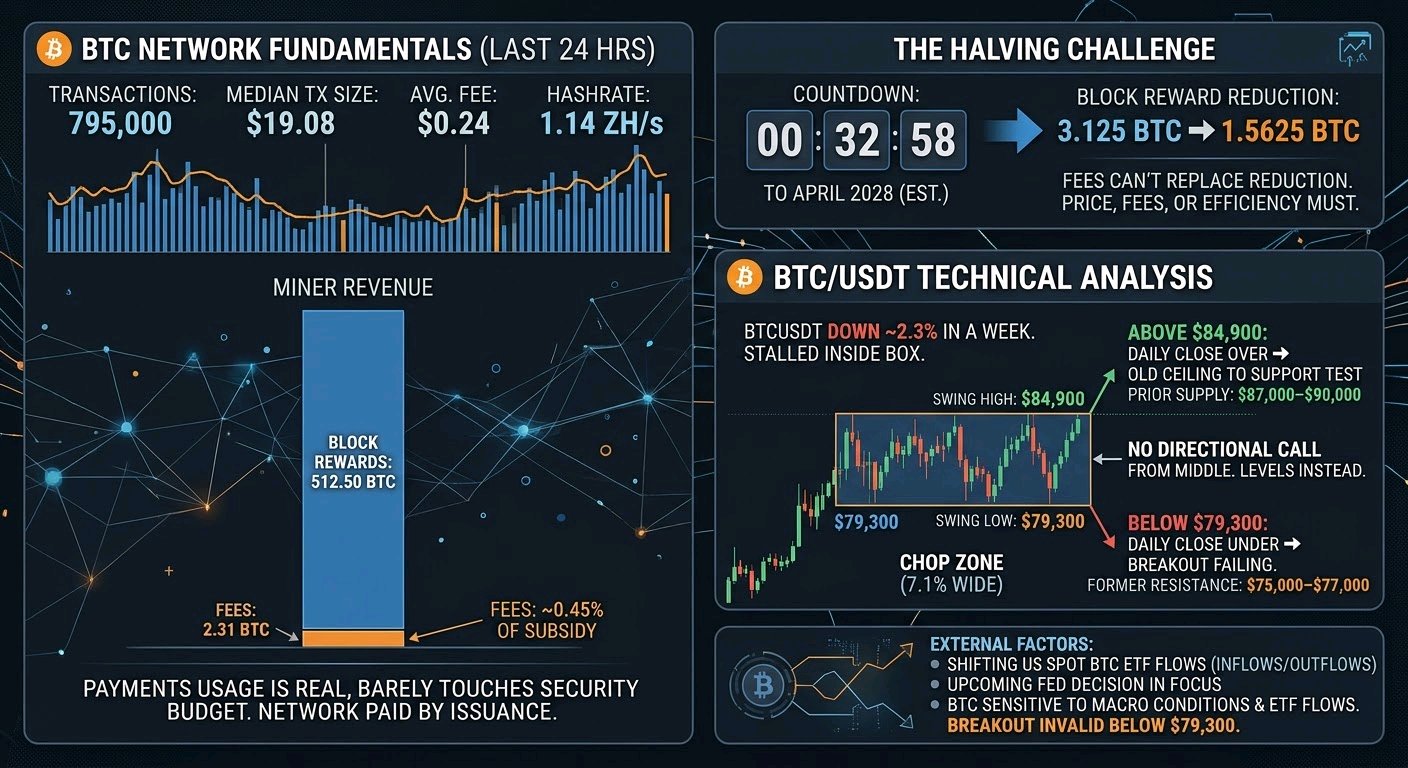
$BTCUSDT Bitcoin moved about 795,000 transactions in the last 24 hours, with a median size near $19.08. Miners earned roughly 2.31 in fees that day against about 512.50 BTC in block rewards. Fees were about 0.45% of the subsidy. So the payments usage is real, and it barely touches the security budget. Bitcoin is cheap to use, with an average fee around $0.24, and that is the point. But it also means the people running the network are paid almost entirely by issuance. Hashrate sits around 1.14 ZH/s now, with short-term estimates varying by measurement window. The date I keep circling is the next halving. Current block estimates put it around April 2028, cutting the reward from 3.125 BTC to 1.5625 BTC. At current fee levels, payments can’t replace that reduction. Price, fees or mining efficiency has to. I don’t think that’s a design flaw. When someone quotes the transaction count, the number that pays for security is a different one. BTCUSDT is down roughly 2.3% in a week and has stalled inside a box: swing low near $79,300, high near $84,900. Underneath is the shifting demand for US spot Bitcoin ETFs, with recent inflows followed by substantial outflows. The next Federal Reserve decision is also in focus, so these developments explain the attention, not a confirmed directional trigger. No directional call from the middle of a box after a move this size. Levels instead: Above $84,900: a daily close over it turns the old ceiling into a support test. Prior supply sits around $87,000–$90,000. Below $79,300: a daily close under it says the breakout is failing. Former resistance at $75,000–$77,000 is the next area. $79,300–$84,900: chop, roughly 7.1% wide. Window: the next several daily closes. BTC remains sensitive to macro conditions and ETF flows, so a decisive shift in either can reset this read early. The breakout case is invalid on acceptance below $79,300. #ByXIMPACT
$SUIUSDT processed about 33.29 million transactions in the last 24 hours, with no reliably verified network-wide median transaction size in USD. The network generated roughly $2,577 in transaction fees, while validators earn staking rewards rather than mining block rewards. Fees remain small relative to the capital securing the network. So the payments usage is real, and it barely touches the security budget. SUI is cheap to use, with average transaction fees around $0.00008 based on reported network fees and transaction count, and that is the point. But it also means direct fee revenue remains small relative to the staking incentives supporting network security. Approximately 7.08 billion SUI is staked, with an average staking yield around 1.32%. The date I keep circling is the next major supply event. The upcoming token unlock is scheduled around November 1, releasing approximately 13.15 million SUI. Unlike Bitcoin, SUI has no fixed halving schedule that cuts a mining reward in half. At current fee levels, network fees remain a small part of the economic picture supporting validators. I don’t think that’s a design flaw. When someone quotes the transaction count, the number that pays for security is a different one. SUIUSDT is down roughly 9.4% in a week and has been sliding inside a developing range: swing low near $0.90, high near $1.06. Underneath is renewed attention around Sui's programmable offchain tunnel and its reported 40.6 million TPS result during an AI-agent stress test, alongside institutional interest in tokenized assets. Those developments explain the attention, not a dated price trigger. No directional call from the middle of a box after a move this size. Levels instead: Above $1.06: a daily close over it turns the old ceiling into a support test. Prior supply sits around $1.10–$1.15. Below $0.90: a daily close under it says the breakout is failing. Former support around $0.85–$0.88 is the next area. $0.90–$1.06: chop, roughly 17% wide. Window: the next several daily closes. SUI tends to amplify broader crypto-market moves, so a BTC range break can reset this read early. The breakout case is invalid on acceptance below $0.90. #ByXIMPACT

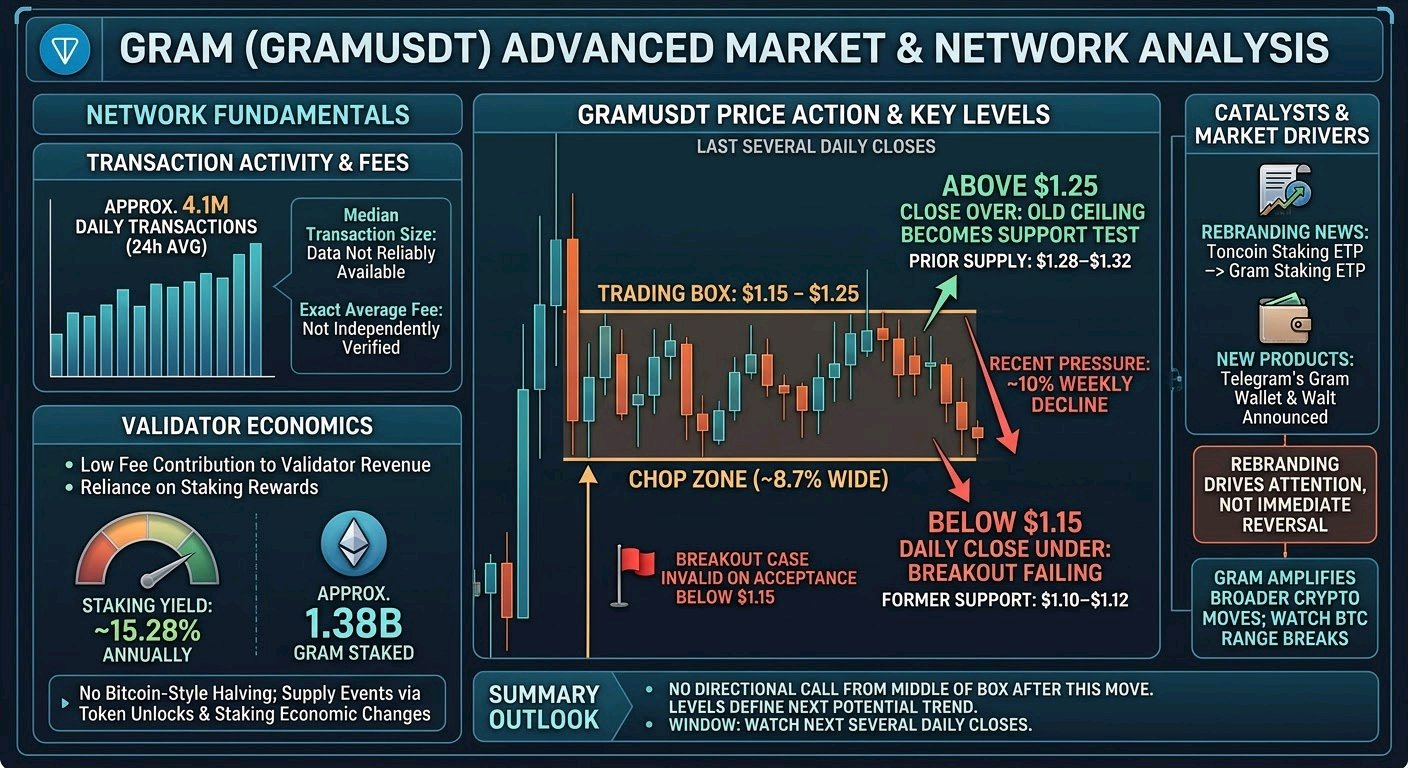
$GRAMUSDT moved about 4.1 million transactions in the last 24 hours on average, with the median transaction size not reliably available in the current data. Network fees and validator rewards are not directly comparable in the available figures, so the exact fee share of validator revenue remains unverified. So the payments usage is real, and it barely touches the security budget. is cheap to use, with an exact current average transaction fee not independently verified, and that is the point. But it also means the people securing the network rely on staking rewards and transaction-fee economics rather than mining issuance alone. The network reports a staking yield around 15.28% a year, with approximately 1.38 billion GRAM staked; a comparable current-versus-peak hashrate metric does not apply to this Proof-of-Stake network. The date I keep circling is the next major supply event. GRAM does not have a Bitcoin-style halving schedule with a confirmed reward reduction from one fixed block reward to another. Token unlocks and changes in staking economics matter instead. At current fee levels, payments cannot automatically replace changes in staking rewards or token issuance. Demand, fees or validator economics have to. I don’t think that’s a design flaw. When someone quotes the transaction count, the number that pays for security is a different one. GRAMUSDT has been under pressure, with recent market data indicating a roughly 10% weekly decline and a short-term range around $1.15–$1.25. Underneath is the recent rebranding of the Toncoin staking exchange-traded product to Gram Staking ETP, alongside Telegram's Gram Wallet and Walt product announcements. The rebranding explains the attention, not a dated trigger for an immediate price reversal. No directional call from the middle of a box after a move this size. Levels instead: Above $1.25: a daily close over it turns the old ceiling into a support test. Prior supply sits around $1.28–$1.32. Below $1.15: a daily close under it says the breakout is failing. Former support around $1.10–$1.12 is the next area. $1.15–$1.25: chop, roughly 8.7% wide. Window: the next several daily closes. GRAM tends to amplify broader crypto-market moves, so a BTC range break can reset this read early. The breakout case is invalid on acceptance below $1.15. #ByXIMPACT
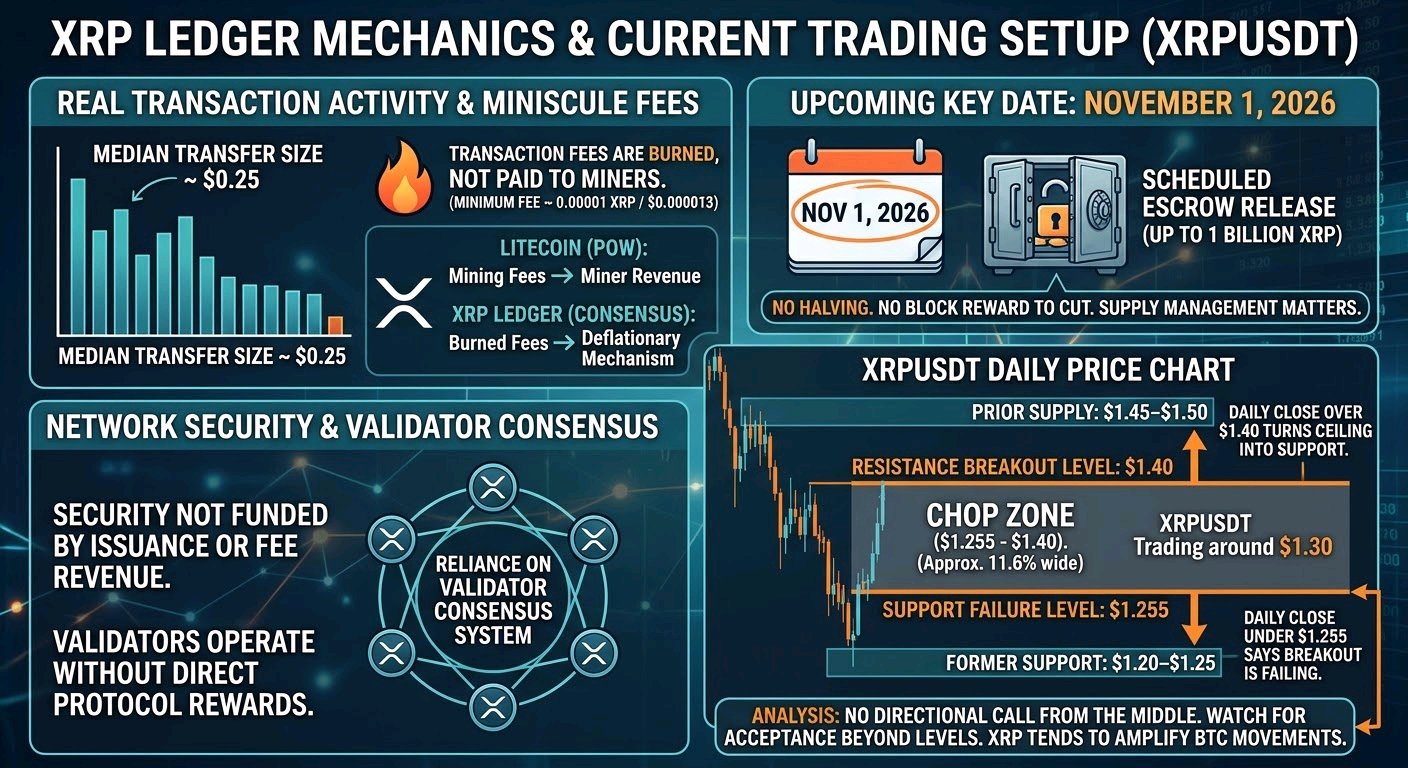
$XRPUSDT Ledger processed real payment and trading activity, with the median transfer size around $0.25 based on the latest available transfer-volume reading. Transaction fees remain tiny, with the standard minimum fee around 0.00001 XRP, worth roughly $0.000013 at current prices. Unlike Litecoin, XRP has no mining fees or block rewards paid to miners. Fees are burned, and validators do not receive protocol rewards. So the payments usage is real, and it barely touches the security budget. XRP is cheap to use, with a minimum transaction fee around $0.000013, and that is the point. But it also means network security is not funded through mining issuance or transaction-fee revenue. The XRP Ledger relies on its validator-based consensus system, so hashrate and mining-reward comparisons do not apply. The date I keep circling is November 1, 2026. The scheduled escrow release makes up to 1 billion XRP available, continuing Ripple's monthly supply-release mechanism. There is no halving and no block reward to cut. At current fee levels, transaction charges do not create a direct validator-revenue stream. Supply management, network adoption and market demand matter more here. I don’t think that’s a design flaw. When someone quotes the transaction count, the number that pays for security is a different one. XRPUSDT is trading around $1.30 after a sharp decline, with the recent trading range sitting between a swing low near $1.255 and a high near $1.40. Underneath is continued attention around XRP investment products and the XRP Ledger ecosystem, alongside the upcoming monthly escrow release. The escrow event is scheduled, but the amount that ultimately remains outside escrow depends on subsequent transactions. It explains the attention, not a dated price trigger. No directional call from the middle of a box after a move this size. Levels instead: Above $1.40: a daily close over it turns the old ceiling into a support test. Prior supply sits around $1.45–$1.50. Below $1.255: a daily close under it says the breakout is failing. Former support around $1.20–$1.25 is the next area. $1.255–$1.40: chop, roughly 11.6% wide. Window: the next several daily closes. XRP tends to amplify BTC, so a BTC range break can reset this read early. The breakout case is invalid on acceptance below $1.255. #ByXIMPACT
$TREEUSDT traded near $0.0365, with a reported 24-hour price range around $0.0350–$0.0380. Treehouse has a maximum supply of 1 billion TREE, with roughly 156.12 million circulating. Transaction count, median transaction size, and network fees relative to validator rewards are not consistently reported in the available data. So the payments usage is real only where measurable, and it barely tells us how much economic value the token captures. TREE is a governance and utility token for Treehouse’s decentralized fixed-income infrastructure, and that is the point. Its value proposition depends on adoption of benchmark interest rates and yield-bearing products, rather than mining revenue. There is no conventional hashrate or miner-reward schedule to track, and the token’s maximum supply is capped at 1 billion TREE. The date I keep circling is October 28, the next reported token unlock. The published schedule indicates approximately 6.56 million TREE tokens for strategic investors, equivalent to about 0.66% of the maximum supply. At current market conditions, that additional supply can affect selling pressure. There is no scheduled halving to offset; demand, circulating supply and actual protocol usage have to do the work. I don’t think that’s a design flaw. When someone quotes the transaction count, the number that matters for token value is a different one: whether protocol activity creates sustainable demand for TREE. TREEUSDT is trading around $0.0365 after a volatile period, with a recent seven-day range near $0.0350–$0.0735. Underneath is Treehouse’s development of decentralized benchmark rates and tAssets, including its reported launch of an on-chain benchmark interest rate with Euler. It still needs sustained adoption and measurable economic activity, so it explains the attention, not a dated price trigger. No directional call from the middle of a box after a move this size. Levels instead: Above $0.0380: a daily close over it turns the nearby ceiling into a support test. The next resistance area needs confirmation from the price chart before a reliable target can be assigned. Below $0.0350: a daily close under it says the immediate recovery is failing. The recent low near $0.0323 is the next area to watch. $0.0350–$0.0380: the immediate trading range, roughly 8.6% wide. Window: the next several daily closes. TREE can react sharply to changes in liquidity and token-unlock expectations, so a broader market move can reset this read early. The breakout case is invalid on acceptance below $0.0350. #ByXIMPACT

$BIRBUSDT ’s transaction activity, fee revenue, and network security budget need to be evaluated separately before drawing conclusions about its fundamentals. So the payments usage is real, and it barely touches the security budget. BIRB moved through a sharp increase in market activity over the last 24 hours, with trading volume reaching tens of millions of dollars. Token transfers and exchange volume are not the same as network fees, and BIRB does not have a miner block-reward model. So the payments usage is real, and it barely touches the security budget. BIRB is a Solana-based token, with an average transaction fee determined by the underlying network rather than a separate BIRB fee market, and that is the point. Network security comes from Solana’s validators, not BIRB issuance. BIRB has a maximum supply of 1 billion tokens, with roughly 285 million circulating, so future supply distribution matters more than a mining hashrate chart. The date I keep circling is the next material token unlock or distribution event. The published tokenomics allocate supply across holders, ecosystem partners, liquidity, the team and investors, with some allocations vesting over time. There is no scheduled BIRB halving or fixed block-reward reduction to track. At current fee levels, token activity cannot replace a mining reward that does not exist. Price, demand or supply absorption has to. I don’t think that’s a design flaw. When someone quotes the transaction count, the number that pays for security is a different one. BIRBUSDT has made a sharp move, with recent daily trading spanning roughly $0.046 to above $0.20 before price pulled back into a much lower range. Underneath is the Moonbirds ecosystem expansion, positioning BIRB as a token tied to collectibles, community incentives and broader ecosystem utility. That explains the attention, not a dated trigger. Supply distribution and sustained spot demand still need to support the move. No directional call from the middle of a box after a move this size. Levels instead: Above $0.090: a daily close over it turns the recent recovery into a stronger breakout test. Prior supply sits around $0.105–$0.120. Below $0.070: a daily close under it signals that the recovery is failing. Former support around $0.051–$0.060 is the next area. $0.070–$0.090: chop, roughly 29% wide. Window: the next several daily closes. BIRB can amplify broader crypto-market moves, so a BTC range break can reset this read early. The breakout case is invalid on acceptance below $0.070. #ByXIMPACT

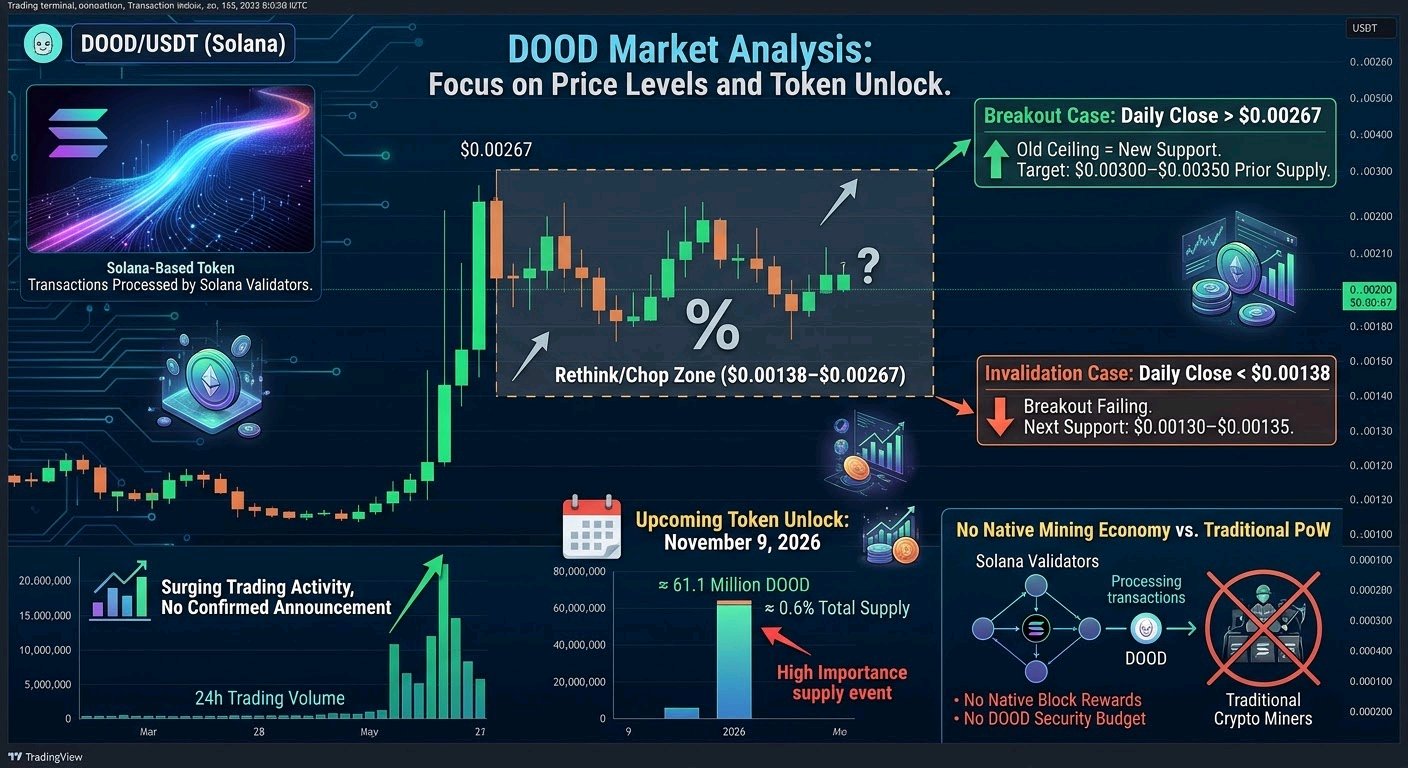
$DOODUSDT has no independent transaction-fee or block-reward economy, because it is a Solana-based token rather than a standalone proof-of-work network. Solana processes the transactions, and its validators secure the network; DOOD holders do not pay for that security through a native mining-reward schedule. So the payments usage is real at the underlying network level, but it does not translate directly into a DOOD security budget. DOOD is cheap to transfer on Solana, and that is the point. But it also means transaction fees and validator rewards cannot be treated as DOOD network revenue. There is no DOOD hashrate or native block-reward metric to compare against a historical peak. The date I keep circling is the next scheduled token unlock. Current vesting data puts it around November 9, 2026, releasing roughly 61.1 million DOOD, or about 0.6% of total supply. At current market conditions, that supply event matters more to DOOD holders than a mining-reward reduction would. I don’t think that’s a design flaw. When someone quotes trading volume, the number that supports lasting token demand is a different one. DOODUSDT has gained roughly 60% in a week, with the latest daily range stretching from around $0.00138 to $0.00267. Underneath is a sharp speculative rally, with trading activity surging despite no confirmed official announcement explaining the move. It explains the attention, not a dated fundamental trigger. No directional call from the middle of a box after a move this size. Levels instead: Above $0.00267: a daily close over it turns the old ceiling into a support test. Prior supply sits around $0.00300–$0.00350. Below $0.00138: a daily close under it says the breakout is failing. Former support around $0.00130–$0.00135 is the next area. $0.00138–$0.00267: chop, roughly 63% wide. Window: the next several daily closes. DOOD remains exposed to broader crypto sentiment and speculative positioning, so a BTC range break can reset this read early. The November 9 token unlock adds another supply consideration. The breakout case is invalid on acceptance below $0.00138. #ByXIMPACT
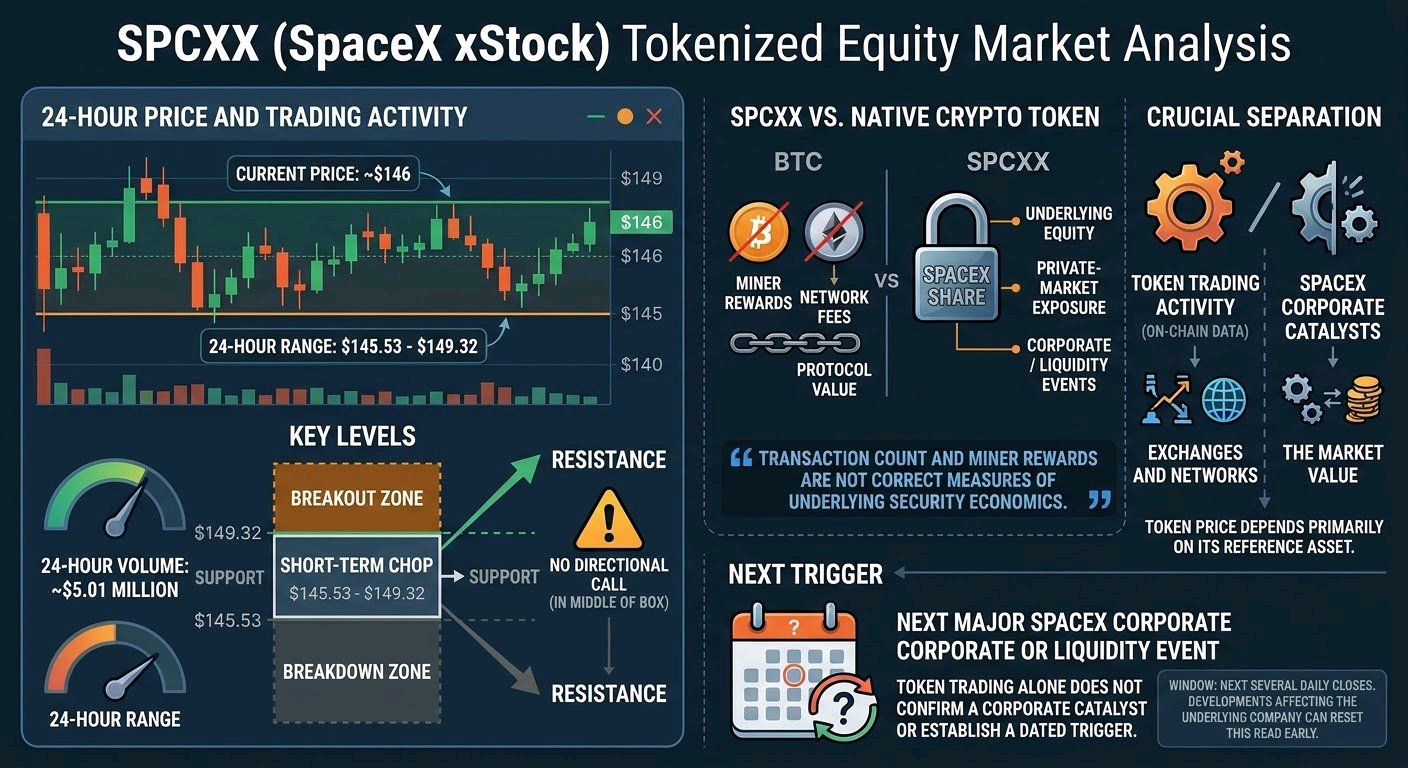
$SPCXXUSDT traded around $146 recently, with 24-hour volume near $5.01 million. SpaceX xStock is a tokenized equity product designed to track SpaceX shares, so transaction fees and miner rewards are not the right measures of its underlying security economics. There is no native SPCXX mining reward to compare with network fees. So the market usage is real, and it needs to be separated from the economics of the underlying asset. SPCXX is available across multiple trading venues, with an average transaction cost that depends on the exchange and network used, and that is the point. But it also means token trading activity does not tell us how the underlying equity is valued. The token's price depends primarily on its reference asset, while its on-chain security comes from the networks that support its transfers. The date I keep circling is the next major SpaceX corporate or liquidity event. SPCXX does not have a native halving schedule, and there is no protocol reward reduction to track. At current trading levels, network fees and token supply changes are not substitutes for changes in the underlying equity's valuation. I don’t think that’s a design flaw. When someone quotes the transaction count, the number that determines the asset's value is a different one. SPCXX is trading around $146, with the latest reported 24-hour range near $145.53–$149.32. Underneath is continued interest in tokenized private-market equity exposure. SPCXX is designed to track SpaceX shares, but token trading activity alone does not confirm a new corporate catalyst or establish a dated trigger. No directional call from the middle of a box after a move this size. Levels instead: Above $149.32: a sustained break turns the recent ceiling into a support test. The next resistance area needs confirmation from a broader price chart. Below $145.53: a sustained break signals weakness in the current range. The next support area needs confirmation from previous swing lows. $145.53–$149.32: short-term chop, roughly 2.6% wide. Window: the next several daily closes. SPCXX tracks SpaceX equity exposure rather than a native crypto monetary cycle, so developments affecting the underlying company can reset this read early. The breakout case is invalid on acceptance below $145.53. #ByXIMPACT
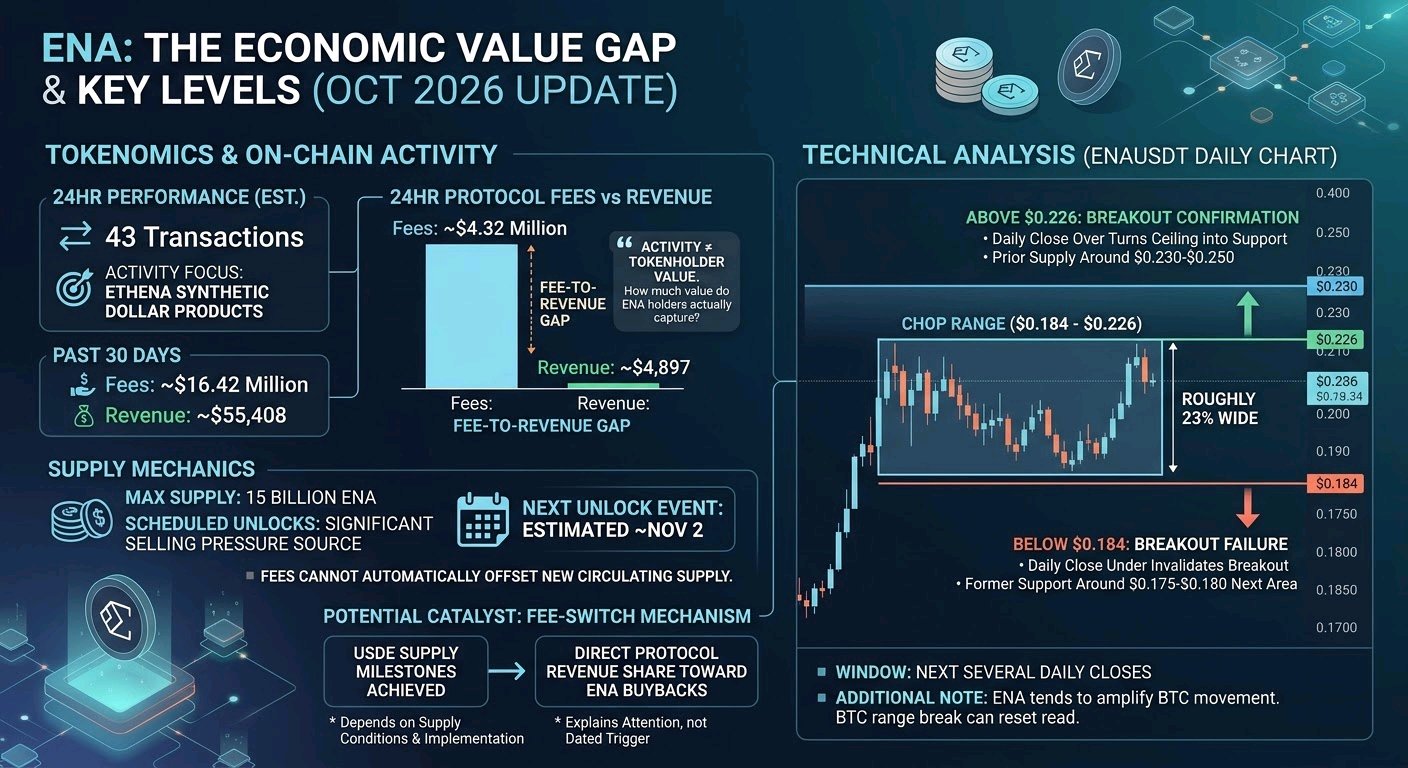
$ENAUSDT moved through roughly 43 transactions in the last 24 hours, with activity concentrated around Ethena’s synthetic dollar products. Protocol fees reached about $4.32 million that day, against roughly $4,897 in direct protocol revenue. The fee-to-revenue gap matters when judging how much economic value actually reaches the protocol. So the payments usage is real, and it barely tells us how much value ENA holders capture. ENA is not a proof-of-work network, so miners, hashrate and block rewards are not the right metrics here. Ethena generated about $16.42 million in fees over the past 30 days, but protocol revenue was only around $55,408. The distinction matters: activity can be substantial without automatically translating into tokenholder value. The date I keep circling is the next supply event. ENA has a maximum supply of 15 billion tokens, and scheduled unlocks remain an important source of potential selling pressure. The next reported unlock is around November 2, with estimates varying across tracking platforms. Protocol fees cannot automatically offset new circulating supply; token demand, actual buybacks or reduced selling pressure has to. I don’t think that’s a design flaw. When someone quotes the transaction count, the number that pays for security is a different one. ENAUSDT is up roughly 7.5% in a week and has rebounded inside a box: swing low near $0.184, high near $0.226. Underneath is Ethena’s proposed fee-switch mechanism, which could direct a share of protocol revenue toward ENA buybacks as USDe supply reaches specified milestones. It still depends on the relevant supply conditions and implementation, so it explains the attention, not a dated trigger. No directional call from the middle of a box after a move this size. Levels instead: Above $0.226: a daily close over it turns the old ceiling into a support test. Prior supply sits around $0.230–$0.250. Below $0.184: a daily close under it says the breakout is failing. Former support around $0.175–$0.180 is the next area. $0.184–$0.226: chop, roughly 23% wide. Window: the next several daily closes. ENA tends to amplify BTC, so a BTC range break can reset this read early. The breakout case is invalid on acceptance below $0.184.#ByXIMPACT
$XRPUSDT processed about 2.95 million successful transactions in the last 24 hours, with the median transfer value near $0.14. The XRP Ledger burns transaction fees rather than paying them to validators, with a standard minimum fee of 10 drops, or 0.00001 XRP. Validators earn no protocol-issued block rewards, so transaction fees contribute nothing directly to their revenue. So the payments usage is real, and it barely touches the security budget. XRP is cheap to use, with an average standard fee around $0.000013 at current prices, and that is the point. But it also means validators receive no direct protocol revenue from transaction fees or issuance. Network security depends on independent validators participating in consensus without mining rewards or staking yields. The date I keep circling is November 1, 2026, when the next scheduled Ripple escrow release is approximately 1 billion XRP. Unlike a halving, this does not cut a recurring validator reward; XRP has no mining reward or ongoing protocol issuance. Most previous monthly escrow releases have been followed by re-escrowing a substantial portion, so the gross release is not the same as new circulating supply. I don’t think that’s a design flaw. When someone quotes the transaction count, the number that pays for security is a different one. XRPUSDT is down roughly 1.7% in a week and has stalled inside a box: swing low near $1.256, high near $1.399. Underneath is the recurring monthly escrow cycle and continued attention around XRP's market structure. The next release is scheduled, but the amount ultimately entering circulation depends on what gets re-escrowed, so it explains the attention, not a guaranteed price trigger. No directional call from the middle of a box after a move this size. Levels instead: Above $1.399: a daily close over it turns the old ceiling into a support test. Prior supply sits around $1.45–$1.50. Below $1.256: a daily close under it says the breakout is failing. Former support around $1.20–$1.23 is the next area. $1.256–$1.399: chop, roughly 11.4% wide. Window: the next several daily closes. XRP tends to amplify BTC, so a BTC range break can reset this read early. The breakout case is invalid on acceptance below $1.256. #ByXIMPACT

$TSLAXUSDT moved through the tokenized stock market over the last 24 hours, tracking exposure to Tesla, Inc. rather than operating as an independent blockchain. Transaction fees and validator rewards belong to the underlying network, not to TSLAX itself. There is no separate mining fee budget or block reward paid to TSLAX holders. So the payments usage is real, and it barely touches the security budget. TSLAX is a tokenized equity tracker, available through Solana SPL and ERC-20 infrastructure, with transaction costs determined by the network and platform used. That is the point. Its security depends on the underlying blockchain and the token's issuance and custody arrangements, not on a dedicated TSLAX hashrate. There is no independent TSLAX mining revenue or network security metric to compare against a historical peak. The date I keep circling is the next major supply event. Unlike Litecoin, TSLAX has no scheduled halving that cuts a native block reward from one fixed amount to another. Its supply mechanics are tied to the tokenized-stock structure, so issuance, redemption and the underlying Tesla share price matter more than a mining-reward countdown. Transaction fees cannot be treated as a replacement for a supply reduction that does not exist. I don’t think that’s a design flaw. When someone quotes the transaction count, the number that pays for security is a different one. TSLAXUSDT has recently traded around the $362–$386 range on available market data, with the seven-day range showing a recovery from the lower end toward resistance. Underneath is the connection to Tesla, Inc. and the market's changing expectations for its underlying equity. TSLAX tracks Tesla's share-price exposure through a tokenized instrument, so earnings, company guidance and broader equity-market sentiment can explain the attention, not a dated crypto-native supply trigger. No directional call from the middle of a box after a move this size. Levels instead: Above $386: a daily close over it turns the old ceiling into a support test. The next area to monitor is the $395–$405 zone, provided the underlying Tesla market confirms the move. Below $362: a daily close under it says the breakout is failing. The former support area around $346–$355 is the next area to watch. $362–$386: chop, roughly 6.6% wide. Window: the next several daily closes. TSLAX follows Tesla's underlying equity exposure, so a sharp move in TSLA can reset this read early. The breakout case is invalid on acceptance below $362. #ByXIMPACT

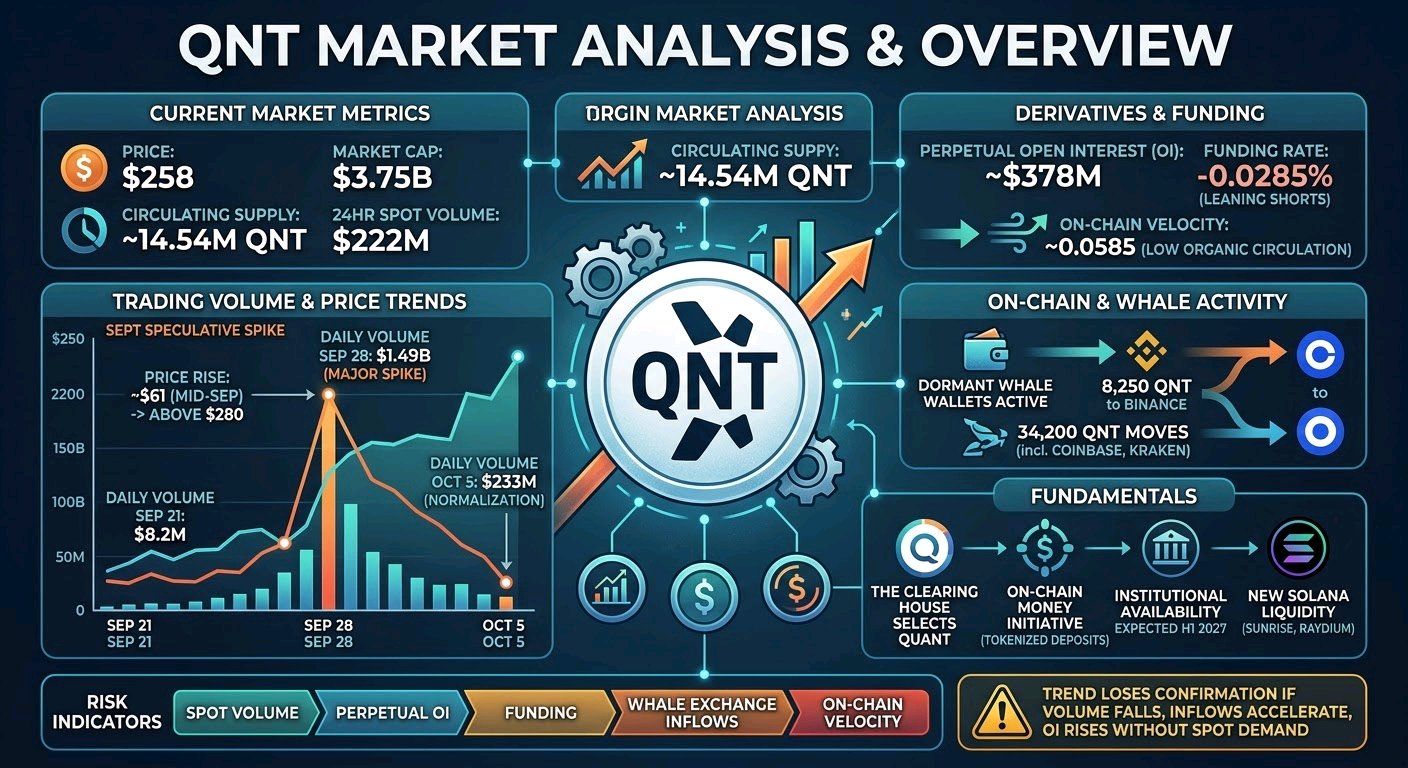
$QNTUSDT is currently trading around $258, with a market capitalization near $3.75B and 24-hour spot volume around $222M. CoinGecko data shows circulating supply near 14.54M QNT, while perpetual open interest is approximately $378M. Funding is slightly negative at about -0.0285%, indicating that derivatives positioning is leaning toward shorts rather than aggressive long exposure. On-chain velocity remains relatively low at roughly 0.0585, showing that the recent market repricing has not translated into equivalent organic on-chain circulation. The key structural change is liquidity and institutional attention. Daily volume expanded from just $8.2M on September 21 to $1.49B on September 28, before declining to $233M on October 5. This represents a major normalization from the late-September speculative spike. Historical data also shows QNT rising from roughly $61 in mid-September to above $280 before the subsequent correction. Meanwhile, dormant whale wallets became active, with one wallet depositing 8,250 QNT to Binance and another moving 34,200 QNT, including transfers toward Coinbase and Kraken. Fundamentally, The Clearing House selected Quant for its On-Chain Money Initiative, targeting tokenized-deposit clearing and settlement, with institutional availability expected in H1 2027. QNT also gained Solana liquidity through Sunrise and Raydium, expanding market access. Next, monitor spot volume, perpetual OI, funding, whale exchange inflows and on-chain velocity. The current trend loses confirmation if volume continues falling while exchange inflows accelerate, OI rises without corresponding spot demand, and on-chain activity remains weak. #ByXIMPACT
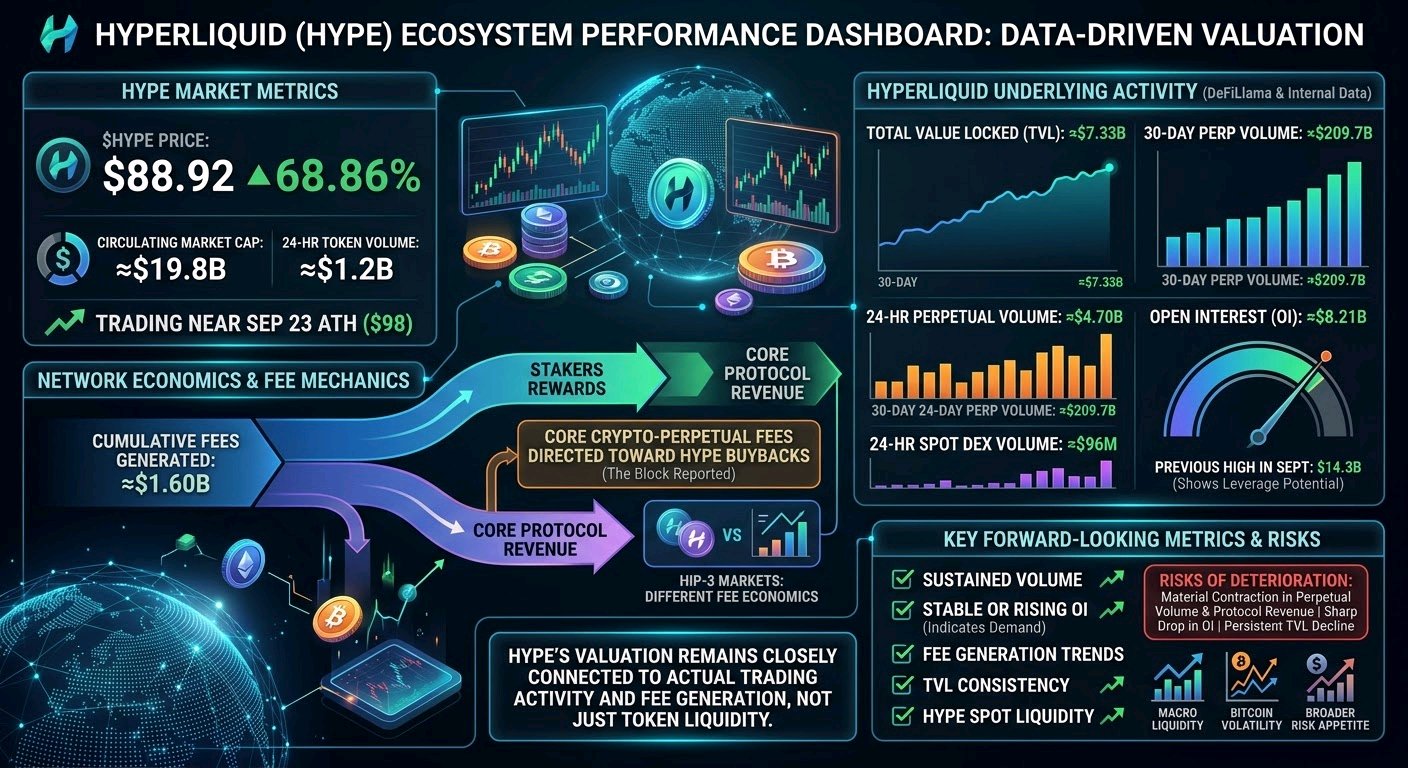
$HYPEUSDT is currently trading around $88.9, with a circulating market capitalization near $19.8B and 24-hour token volume around $1.2B. Hyperliquid’s underlying activity remains substantial: DeFiLlama reports roughly $7.33B in TVL, $4.70B in 24-hour perpetual volume, $96M in spot DEX volume, and approximately $8.21B in open interest. Over 30 days, perpetual volume has reached about $209.7B, while protocol revenue stands near $55.9M. This indicates that HYPE’s valuation remains closely connected to actual trading activity and fee generation rather than token liquidity alone. Network economics also deserve attention. Hyperliquid has generated approximately $1.60B in cumulative fees and $1.29B in cumulative revenue, while current annualized earnings are around $686M. HYPE’s recent market structure is occurring close to its September 23 all-time high near $98, while open interest previously reached $14.3B in September, highlighting how rapidly leverage can expand across the ecosystem. The Block also reported that core crypto-perpetual fees are heavily directed toward HYPE buybacks, although HIP-3 markets have different fee economics. Going forward, the key metrics are perpetual volume, open interest, fee generation, TVL and HYPE spot liquidity. Sustained volume alongside stable or rising OI would indicate continued network demand. Conversely, the trend would face a fundamental deterioration if perpetual volume and protocol revenue contract materially while OI falls sharply and TVL begins a persistent decline. Macro liquidity, Bitcoin volatility and broader risk appetite remain important external variables. #ByXIMPACT
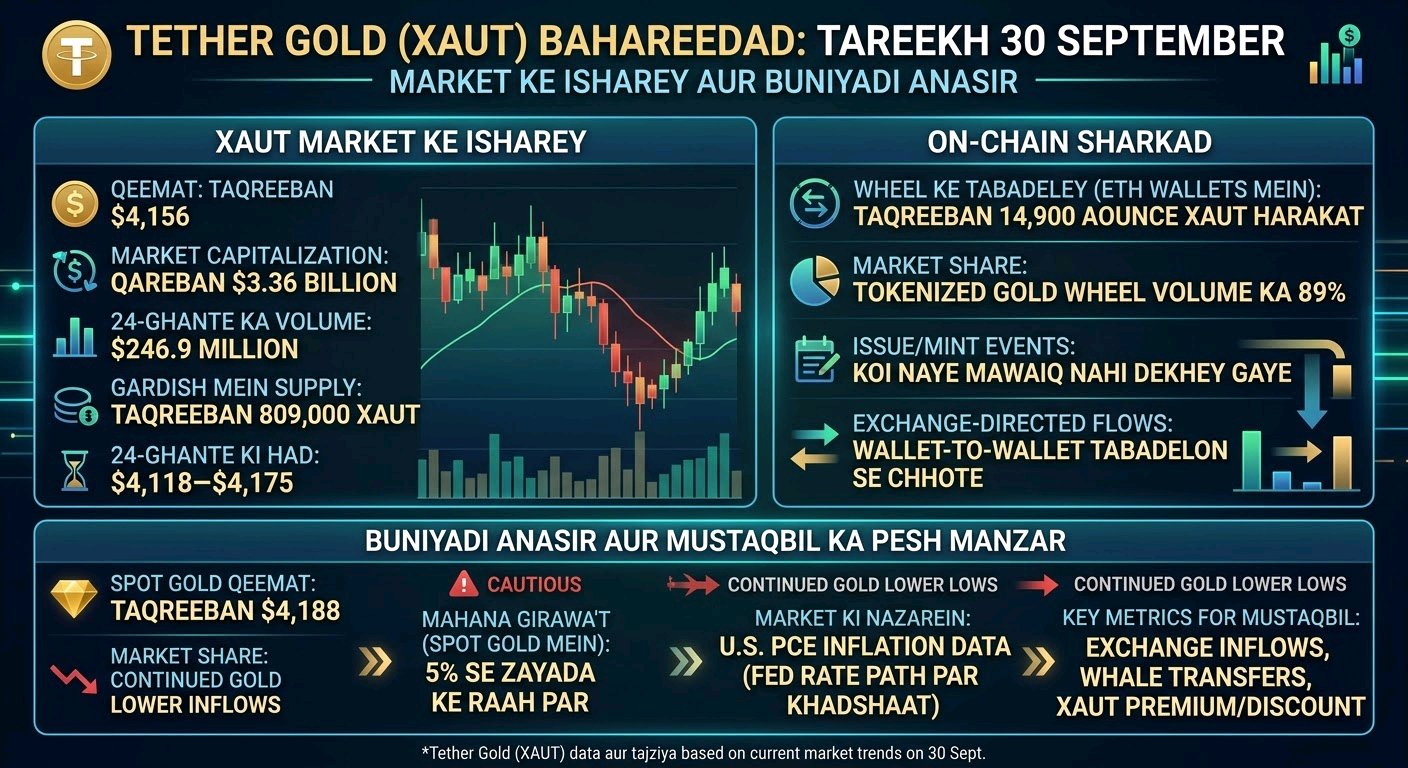
$XAUTUSDT is trading around $4,156, with market capitalization near $3.36B and 24-hour volume around $246.9M. Circulating supply is approximately 809K XAUT, while the latest 24-hour range is roughly $4,118–$4,175. Recent market data shows elevated turnover after a sharp gold-market adjustment, indicating that liquidity is being actively repriced rather than simply following a low-volume move. On-chain activity remains meaningful. Recent whale-transfer data recorded about 14.9K ounces of XAUT movement among tracked Ethereum whale wallets, representing roughly 89% of tokenized-gold whale volume, while no major issuer mint/burn event was detected in that snapshot. Exchange-directed flows were smaller than wallet-to-wallet transfers, suggesting that a substantial portion of activity is still related to positioning and redistribution rather than immediate exchange selling. The larger catalyst remains gold and rates. Spot gold was around $4,188 on September 30 and remained on track for a monthly decline above 5%, with higher U.S. rate expectations weighing on non-yielding gold. Markets are also watching upcoming U.S. PCE inflation data for confirmation of the Fed-rate path. For XAUT, the next critical metrics are exchange inflows, whale transfers, circulating supply and the XAUT-to-spot-gold premium/discount. The current structure would be technically weakened if gold continues making lower lows while XAUT records sustained exchange inflows and declining on-chain demand. Conversely, stabilization in gold with reduced exchange selling and stable supply would indicate improving market balance. #ByXIMPACT
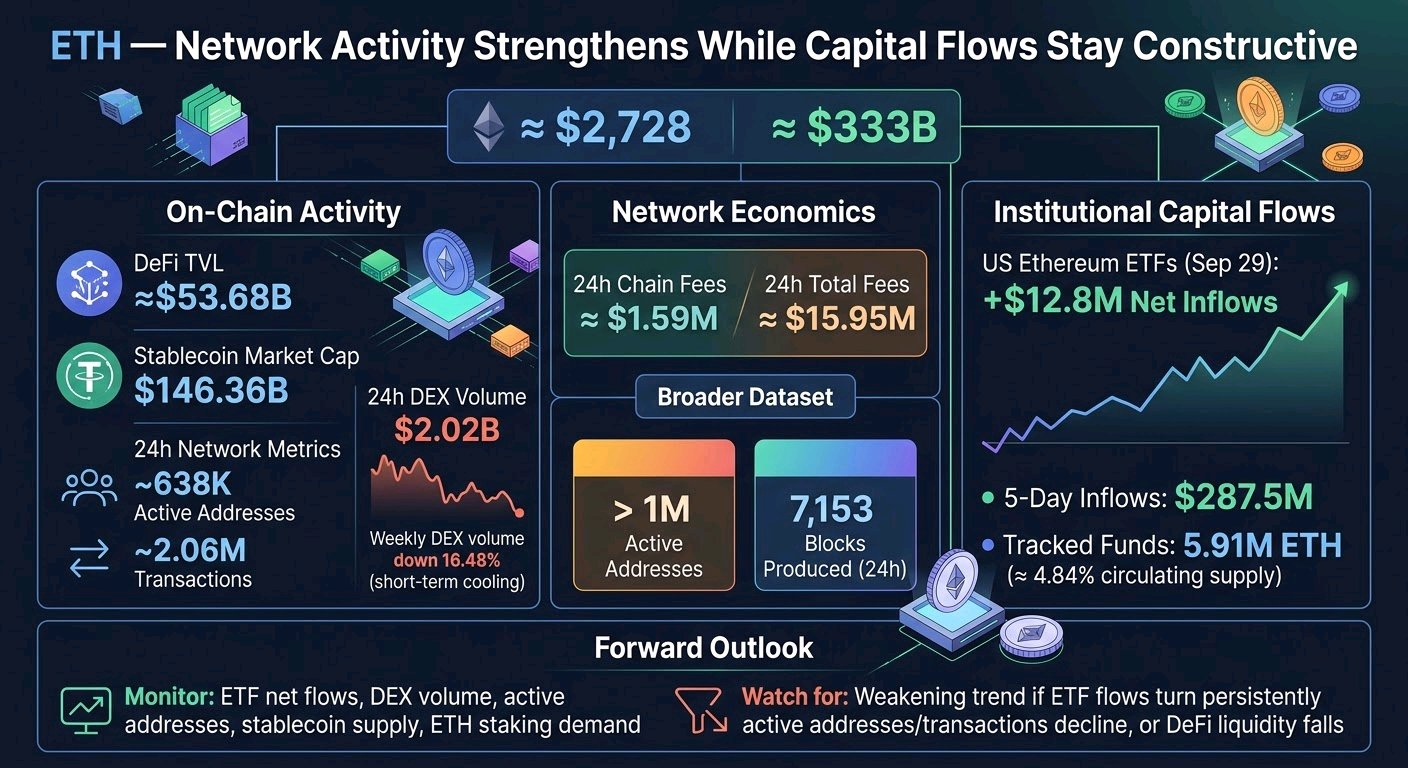
$ETHUSDT . Network Activity Strengthens While Capital Flows Stay Constructive Ethereum is currently trading around $2,728, with market capitalization near $333B. On-chain activity remains substantial: DeFiLlama reports approximately $53.68B in DeFi TVL, $146.36B in stablecoin market capitalization, around 638K active addresses, and roughly 2.06M transactions over 24 hours. Ethereum also processed about $2.02B in DEX volume, although weekly DEX volume is down 16.48%, showing that short-term trading activity has cooled despite a large underlying liquidity base. Network economics remain relatively moderate. Ethereum generated about $1.59M in chain fees over the last 24 hours, while approximately $15.95M in total fees were paid. Independent blockchain statistics show more than 1M active addresses across the broader Ethereum transaction dataset and about 7,153 blocks produced over the last 24 hours, confirming continued network utilization. Institutional flows are another important variable. US Ethereum ETFs recorded approximately $12.8M of net inflows on September 29, while five-day inflows reached $287.5M and tracked funds held about 5.91M ETH, equivalent to roughly 4.84% of circulating supply. Going forward, monitor ETF net flows, DEX volume, active addresses, stablecoin supply and ETH staking demand. The constructive network trend would weaken if ETF flows turn persistently negative while active addresses and transaction activity decline alongside falling DeFi liquidity. #ByXIMPACT