ali***@****
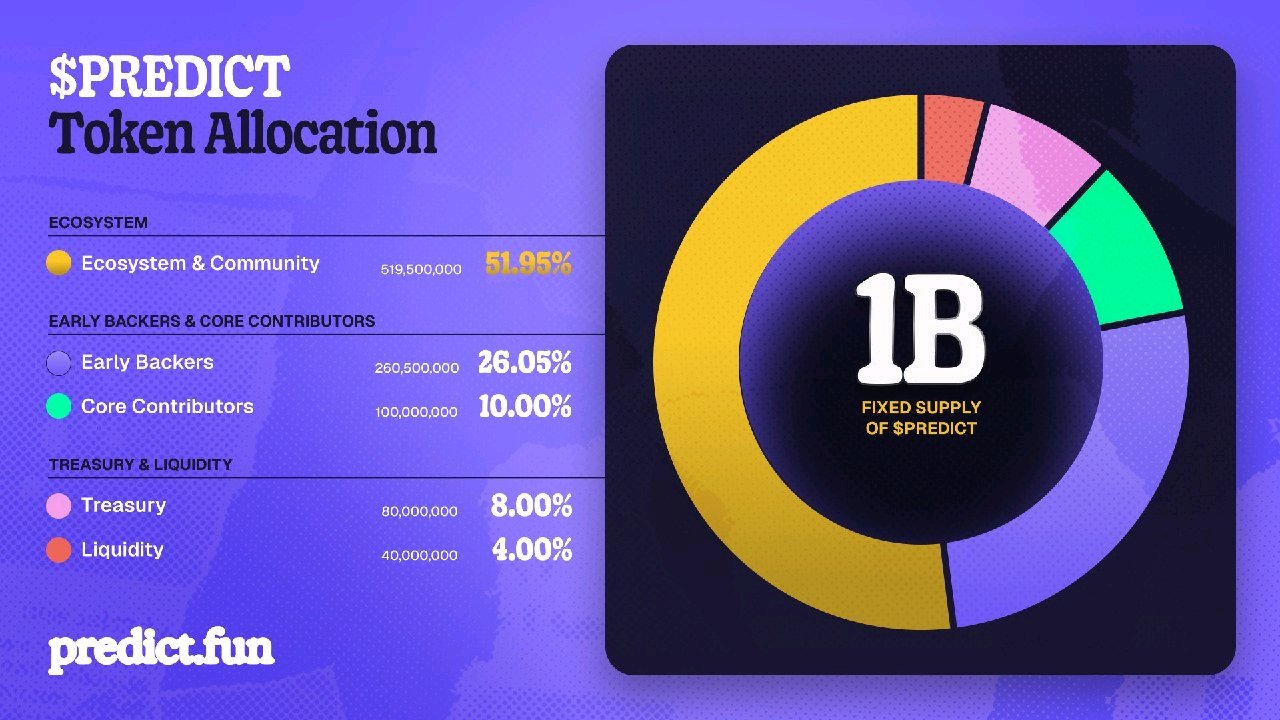
PREDICT TGE Analysis: High FDV, Aggressive Airdrop Mechanics, and the Binance IDO Gamble As a crypto trader, you already know the game: a hot prediction market project, a massive FDV, and the classic "take the money and run" airdrop dilemma. Here’s the breakdown of what’s actually happening with $PREDICT and how to position yourself. Tokenomics: Supply Overhang and the TGE Unlock The headline is the 1B fixed supply, but the devil is in the details. · Ecosystem & Community (51.95%): This is the largest chunk, but 70M (7%) is earmarked for the Season 1 airdrop. The rest is subject to long-term emission schedules. · Early Backers & Core Contributors (36.05%): This is the most critical data point. These allocations are fully locked at TGE with a 24-month cliff followed by a 36-month vesting schedule . This means no VC or team selling pressure on day one, which is a massive positive for the initial price action. · Circulating Supply at TGE: 16% of the total supply (160M tokens) will be in circulation. This is relatively high, but given the lockups, the actual float might be manageable if market makers absorb the airdrop sells. The Airdrop: The "Greedy vs. Patient" Dilemma The 70M token airdrop (7% of supply) comes with a predatory mechanic that you need to game: · Option A (Instant Gratification): Claim 35% immediately. The remaining 65% is burned/forfeited forever . This is designed to create sell pressure on day one. · Option B (The Long Game): 100% of the allocation via 12-month vesting. You have a one-month window post-TGE to change your mind and downgrade to Option A . · Trader Strategy: If you are farming the airdrop, Option B is mathematically superior unless you desperately need liquidity. The 35% instant claim essentially values your allocation at a ~65% penalty. Even if you plan to sell, vesting allows you to sell into potential pumps over the year rather than capitulating to the initial TGE dump. The Binance IDO and FDV Reality Check Tomorrow’s Binance Wallet IDO is the immediate catalyst. While the exact Alpha Points requirement is unclear, the pre-market data is screaming overvaluation: · Pre-Market FDV: It is currently trading around $1.4B to $1.64B FDV, with a recent pump touching $2B . · The Risk: A $1.4B FDV for a project with minimal initial float is a massive ask. As a trader, you must calculate the Point Value. If the FDV holds at $1.4B, the implied price is $1.40 per token. However, airdrop farmers who took Option A will likely dump their 35% immediately. This creates a scenario where the actual spot listing could see significant downside volatility unless there is aggressive market-making. · The Verdict: The FDV is currently driven by hype and perp pre-market mechanics, not actual user adoption. Do not chase the pre-market price. If you are participating in the Binance IDO, treat it as a short-term flip. If the FDV opens above $1.5B, the risk/reward for holding is poor. Summary $PREDICT has a clean TGE float (no VC dumps), but the 16% unlock and the airdrop's "burn 65%" mechanic are designed to test your conviction. The $1.4B+ FDV is rich. If you get an IDO allocation, consider taking profits on the initial listing volatility rather than holding for a "1B supply" long-term play. #PREDICT #BinanceIDO #Tokenomics #TGE #CryptoTrader
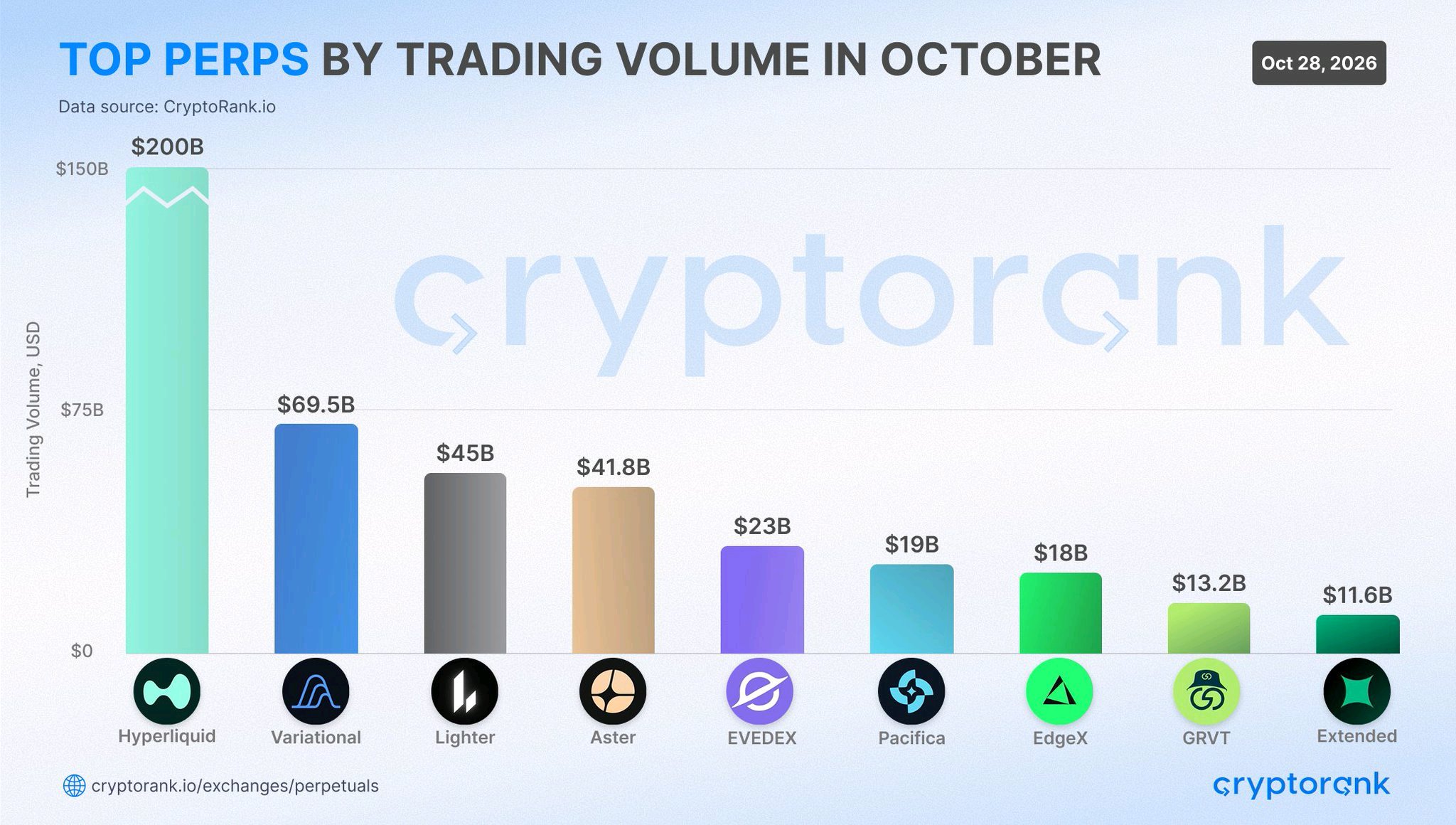
Hyperliquid's 35% Market Share: Volume Leadership Meets Data Quality Questions The headline figure is eye-catching: Hyperliquid processed $200 billion in perpetual futures volume during October, capturing nearly 35% of the entire on-chain perps market. The ranking that follows—Variational at $69.5B, Lighter at $45B, Aster at $41.8B, EVEDEX at $23B—paints a picture of a market with a clear leader and a crowded chasing pack. But as any seasoned perps trader knows, volume alone is a vanity metric. The more important question is: what kind of volume, and at what cost? The Bull Case: Hyperliquid's Structural Moat Hyperliquid's dominance is not accidental. Its custom L1 architecture delivers sub-second block latency and order book depth that rivals centralized exchanges—a prerequisite for attracting professional market makers and high-frequency flow . Unlike many competitors, Hyperliquid has built its moat on infrastructure rather than token incentives. The open interest-to-volume ratio tells a revealing story. Hyperliquid has historically maintained an OI/Volume ratio north of 280%, compared to Aster's approximately 12% . A high ratio indicates that positions are being held, not just churned. It suggests genuine directional conviction and hedging activity rather than wash trading designed to farm airdrop points. This distinction matters enormously for anyone trading on these venues. Deep, sticky open interest means tighter spreads, better fill quality, and less slippage on size. Volume that exists only to game a points program evaporates the moment incentives end. The Aster Problem: When Volume Doesn't Tell the Full Story The inclusion of Aster at $41.8B deserves scrutiny. In October, DefiLlama delisted Aster from its dashboard due to concerns that its reported volumes were mirroring Binance perpetuals data almost exactly . The platform's OI stood at roughly $4.86B against $41.78B in daily volume—a ratio that, as noted, is an order of magnitude below Hyperliquid's . For traders, the lesson is straightforward: not all perp DEX volume is created equal. Platforms that rely on aggressive token emissions or points programs to inflate activity may offer short-term trading opportunities, but they carry hidden risks. Liquidity can vanish. Execution quality can deteriorate. The counterparty you're trading against may not be what it appears. What This Means for Your Trading If you're trading size: Hyperliquid remains the default venue for on-chain perps. The depth is real, the latency is competitive, and the OI profile suggests a healthier market structure than the alternatives. That said, concentration risk is a factor—any single-venue dependency deserves monitoring. If you're hunting incentives: Lighter, Variational, and Aster all have active points or airdrop narratives. The volumes are real in the sense that trades are executing, but the durability of that liquidity post-incentive is unproven. Size positions accordingly and do not assume current spreads will persist. If you're watching the sector: The 35% figure is a snapshot, not a permanent state. October saw record total perp DEX volume of roughly $1.2 trillion, driven by incentive programs and a major liquidation event on October 10 . As those tailwinds fade, market share may shift. Hyperliquid's structural advantages should keep it in the lead, but the gap may narrow if competitors improve execution rather than just emissions. The Bottom Line Hyperliquid's 35% share is a legitimate achievement built on infrastructure, not just incentives. But the ranking below it is a mixed bag. Traders should use volume as a starting point for research, not a conclusion. Check open interest. Check spread history. Check whether the platform's volume survives when the points programs end. In perps, liquidity is oxygen. Make sure you're breathing the real thing.
🐋 Whale Radar: WhiteBIT, Bitget & Gnosis Lead the Pack in $100K+ Transaction Surge In the fast-paced world of cryptocurrency, following the "smart money" is often the key to spotting the next big trend. According to the latest data from on-chain analytics platform Santiment, there has been a significant shift in whale activity over the past 7 days. The metric in focus? The rise in the number of transactions exceeding $100,000, specifically filtering for projects with a market capitalization above $100M. Here is a breakdown of the top projects witnessing a surge in high-net-worth investor interest. 🥇 The Top Performers: Exchanges & Infrastructure 1. WhiteBIT Token (WBT) – +1000% The standout performer is WBT, which saw a staggering 10x increase in whale transactions compared to the previous week. Despite a price dip of over 52% in the last 24 hours (likely due to volatility or a specific market event), the massive spike in large transactions suggests that whales are actively accumulating or moving funds on the WhiteBIT exchange. With a market cap of $6.7B, this is a major signal for the exchange sector. 2. Bitget Token (BGB) – +400% Following closely is BGB with a 400% rise in $100K+ transactions. Unlike WBT, BGB is showing green candles with a +20.46% volume increase over the last day. This indicates strong bullish momentum and high liquidity confidence from large holders. 3. Gnosis (GNO) – +300% Gnosis, a veteran in the Prediction Market and DeFi space, saw a 300% increase in whale activity. The price has remained relatively stable (+0.48%), but the volume spike (+119%) suggests that infrastructure players are positioning themselves ahead of potential ecosystem updates. 🚀 The Rest of the Top 10 The trend isn't limited to exchanges. We are seeing significant activity in Layer 2 and Staking solutions: · Mantle (MNT): +275% (Layer 2 scaling is heating up). · Frax Staked Ether (SFRXETH): +200% (Liquid staking derivatives remain a whale favorite). · Maker (MKR): +200% (DeFi governance tokens are seeing renewed interest). 💡 Trader’s Takeaway What does this data tell us? While retail traders might be focused on price charts, whales are moving size on Exchange Tokens (WBT, BGB) and DeFi Infrastructure (GNO, MKR). · Watch for Utility: The surge in WBT and BGB suggests exchange tokens are being utilized for fees or holding benefits. · Accumulation: High transaction counts often precede volatility. Keep a close eye on the order books for these assets. ⚠️ Caution: Always remember that whale activity can also indicate large sell-offs. Use this data in conjunction with price action and volume analysis before making a move. #Crypto #WhaleAlert #DeFi #WBT #BGB
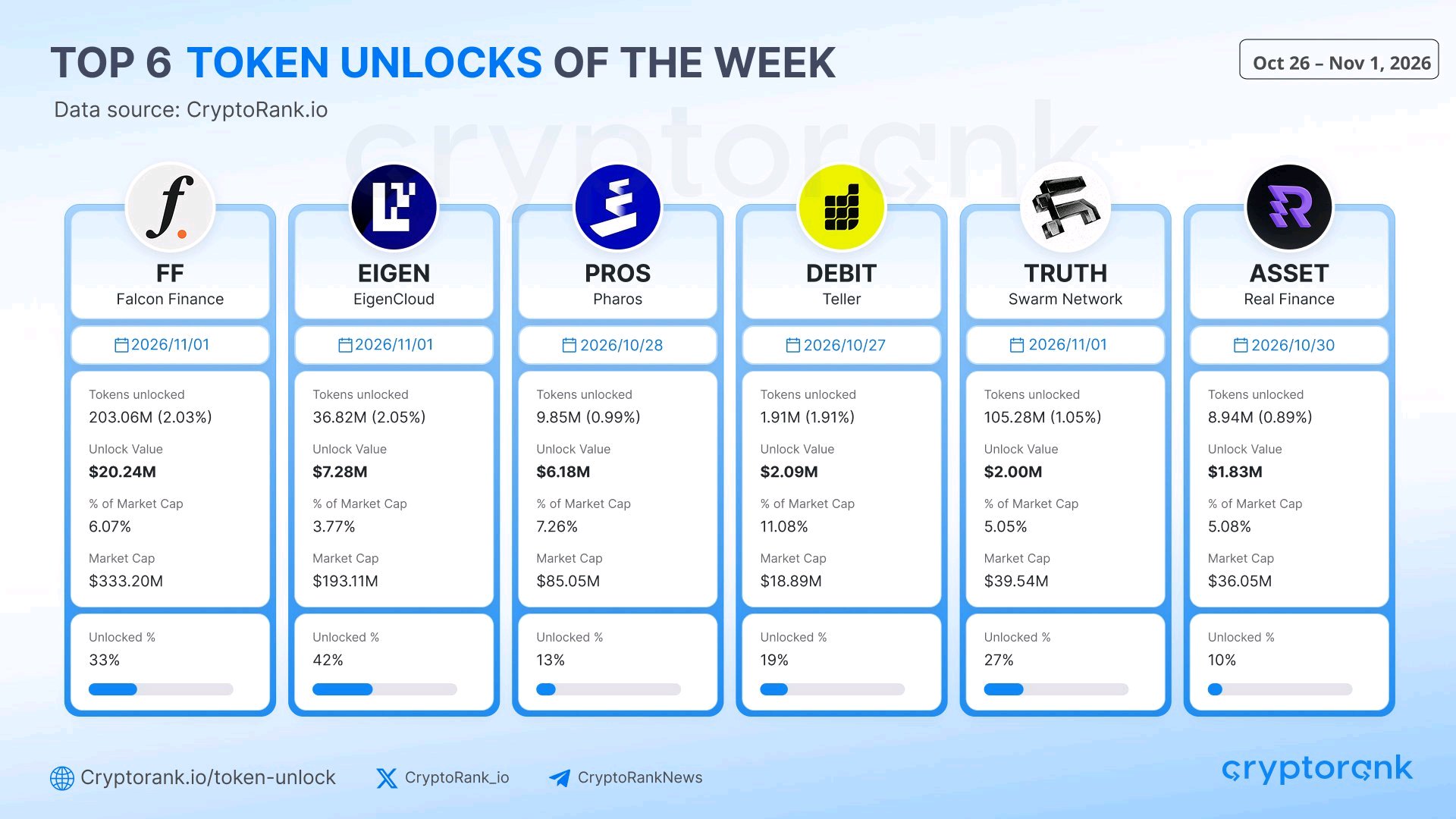
⚠️ Weekly Unlock Alert: Navigating the $40M+ Supply Shock (Oct 26 – Nov 1) Fellow traders, it’s that time of the week again. As we head into the last week of October, we are facing a series of significant token unlocks that could dictate short-term price action. In crypto, narrative is everything, but tokenomics is the reality check. When supply increases and liquidity doesn't match, the order books get heavy. Let’s break down the top 6 unlocks over the next seven days and how to position ourselves. Here is the data from CryptoRank: 1. $FF (Falcon Finance) – The Heavyweight · Unlock Value: $20.24M (203.06M tokens) · % of Market Cap: 6.07% · Date: Nov 1 · Trader’s Take: This is the elephant in the room. FF accounts for more than half of the total unlock value this week. While 2.03% of the total supply is hitting the market, the 6.07% of Market Cap impact is substantial. Expect high volatility. If you are holding, watch for resistance near local highs; if you are trading, wait for the "sell the news" dip to stabilize before entering. 2. $EIGEN (EigenCloud) – The Hype Check · Unlock Value: $7.28M (36.82M tokens) · % of Market Cap: 3.77% · Date: Nov 1 · Trader’s Take: Eigen has been a market darling, but a 3.77% MCap unlock is nothing to ignore. 42% of the tokens are already unlocked, meaning the vesting schedule is well underway. Keep an eye on the $2.00 psychological levels (assuming price action aligns with the current cap). If the market absorbs this well, it’s a bullish signal for the rest of Q4. 3. $PROS (Pharos) – The High Dilution Play · Unlock Value: $6.18M (9.85M tokens) · % of Market Cap: 7.26% · Date: Oct 28 · Trader’s Take: Here is the red flag for the week. 7.26% of the Market Cap is being unlocked, yet the overall market cap is relatively low ($85M). This represents significant dilution relative to its size. Be very cautious with $PROS on Tuesday. Unless there is a massive catalyst to drive buy-side volume, the increased float could suppress price. 4. $DEBIT (Teller) – The Micro-Cap Squeeze · Unlock Value: $2.09M (1.91M tokens) · % of Market Cap: 11.08% (!) · Date: Oct 27 · Trader’s Take: This is the most dangerous unlock on the list relative to its size. $DEBIT has a market cap of just under $19M. Unlocking 11% of the market cap in one go creates a massive supply shock for a low-liquidity asset. This is a "stay away" or "short on breakdown" setup. Do not try to catch a falling knife here unless you see massive accumulation. 5. $TRUTH (Swarm Network) & $ASSET (Real Finance) – The Others · TRUTH: $2.00M (5.05% of MCap) – Nov 1 · ASSET: $1.83M (5.08% of MCap) – Oct 30 · Trader’s Take: Both of these represent roughly 5% of their respective market caps. These are moderate impacts. For $TRUTH and $ASSET, check the 1-hour chart post-unlock for "wick" rejections or swift recovery candles. If the price holds above the unlock candle's body, it signals strength. --- 🎯 Tactical Summary & Conclusion For the upcoming week, the aggregate unlock pressure is roughly $39.6M. · The Big Risk: $DEBIT and $PROS. The percentage of market cap unlocked is too high for their respective liquidity profiles. · The Watchlist: $FF. If $20M of FF tokens are absorbed without price breaking support, it shows strong accumulation and bullish conviction. Trading Strategy: 1. Don't front-run the unlock. Let the tokens hit the market. 2. Watch the volume. Low volume during an unlock = slow bleed. High volume = either capitulation or absorption. 3. Manage risk. Use tight stop-losses on any positions you take this week. Stay sharp, manage your risk, and trade the chart, not the hope. 💡📉
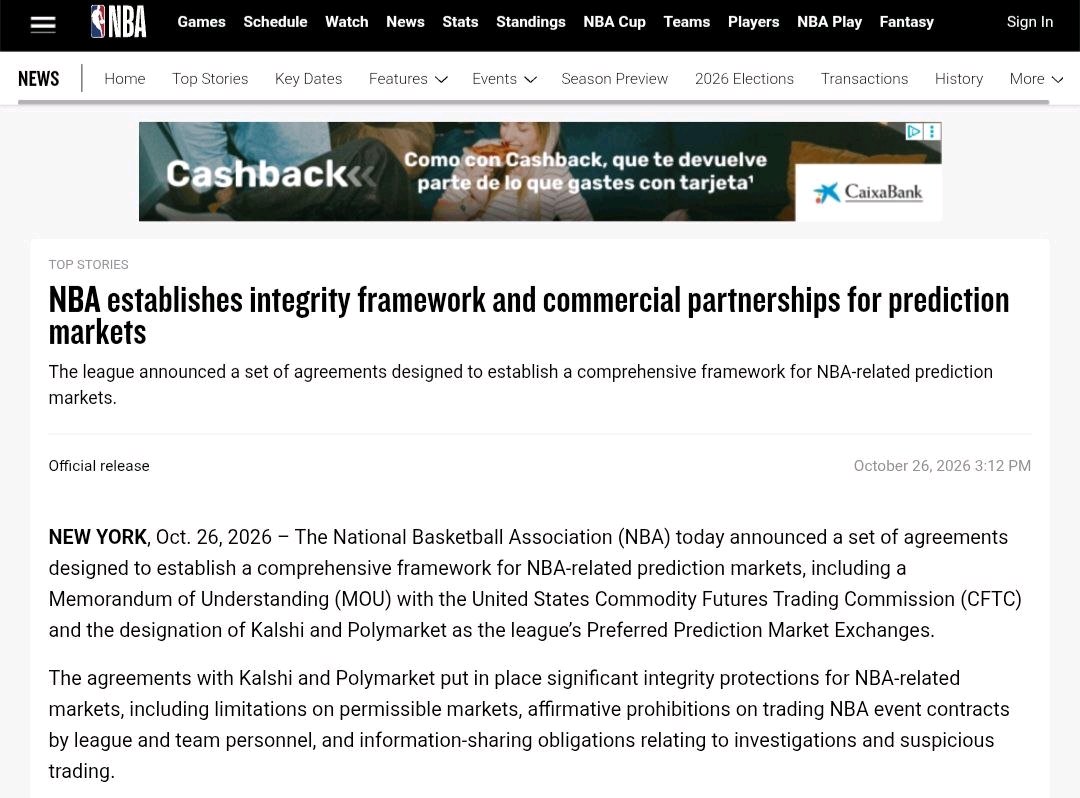
The Institutional Floodgates Are Opening: NBA Officially Embraces Prediction Markets with Polymarket & Kalshi Fellow traders, we just witnessed a massive paradigm shift in how traditional sports leagues interact with Web3 and prediction markets. If you’re not paying attention to the prediction market sector right now, you are missing one of the biggest structural plays of this cycle. Let’s break down the macro implications of the NBA’s latest move. The Headlines: The NBA has officially announced strategic partnerships with the two heaviest hitters in the prediction market space: Polymarket (Web3 native) and Kalshi (CFTC-regulated). Both platforms will now hold the status of "Preferred Prediction Market Exchanges" for the league. But this is much deeper than just slapping an NBA logo on a website. Here are the core mechanics of the deal: · Official Data Access: Both platforms get access to official league data. · IP Rights: They can use NBA logos and intellectual property. · Integrity & Regulation: The NBA will actively participate in defining contract terms, implement strict information-sharing protocols to investigate suspicious trading, and ban league/team personnel from trading NBA event contracts. Furthermore, the NBA is working closely with the US CFTC to bolster oversight. The Crypto Trader's Take: Why This is Bullish AF 1. The "Web2 meets Web3" Bridge is Built: Polymarket has already proven its product-market fit during recent global elections. By integrating with the NBA, Polymarket gets mainstream, institutional legitimacy. This forces mainstream audiences to interact with crypto rails (even if they don't realize it via account abstraction) to express their opinions on sports. 2. Regulatory Clarity & CFTC Alignment: The inclusion of Kalshi (fully US-regulated) and the direct cooperation with the CFTC is the most crucial part. The NBA isn't running away from regulators; they are shaping the framework. This sets a massive precedent for other leagues (NFL, MLB, UEFA). It signals that prediction markets are no longer a gray area—they are becoming a regulated asset class. 3. Volume Explosion Incoming: Sports are the ultimate liquidity magnet. We know the order flow that sports betting generates. If even a fraction of that volume shifts into on-chain prediction markets during the NBA season, the TVL and volume metrics for projects in this sector will go parabolic. 4. Integrity = Institutional Money: Institutional capital hates manipulation. By establishing a framework that bans insider trading (players/team staff) and shares data for investigations, the NBA is de-risking the market. This makes it safer for larger liquidity providers to enter the space. My Play / What to Watch: This news validates the "InfoFi" (Information Finance) narrative. While we don't have a direct token for Polymarket (yet), we should watch for two things: 1. Volume spikes on prediction market aggregators and related DEXs as the NBA season progresses. 2. Ecosystem plays: Protocols building decentralized oracles and data feeds that could potentially integrate with these platforms. The narrative is clear: Prediction markets are transitioning from "crypto degens gambling on elections" to a legitimate, regulated financial vertical backed by multi-billion dollar sports leagues. Position accordingly. Stay sharp, manage your risk, and always trade the narrative before the crowd. 🏀📈
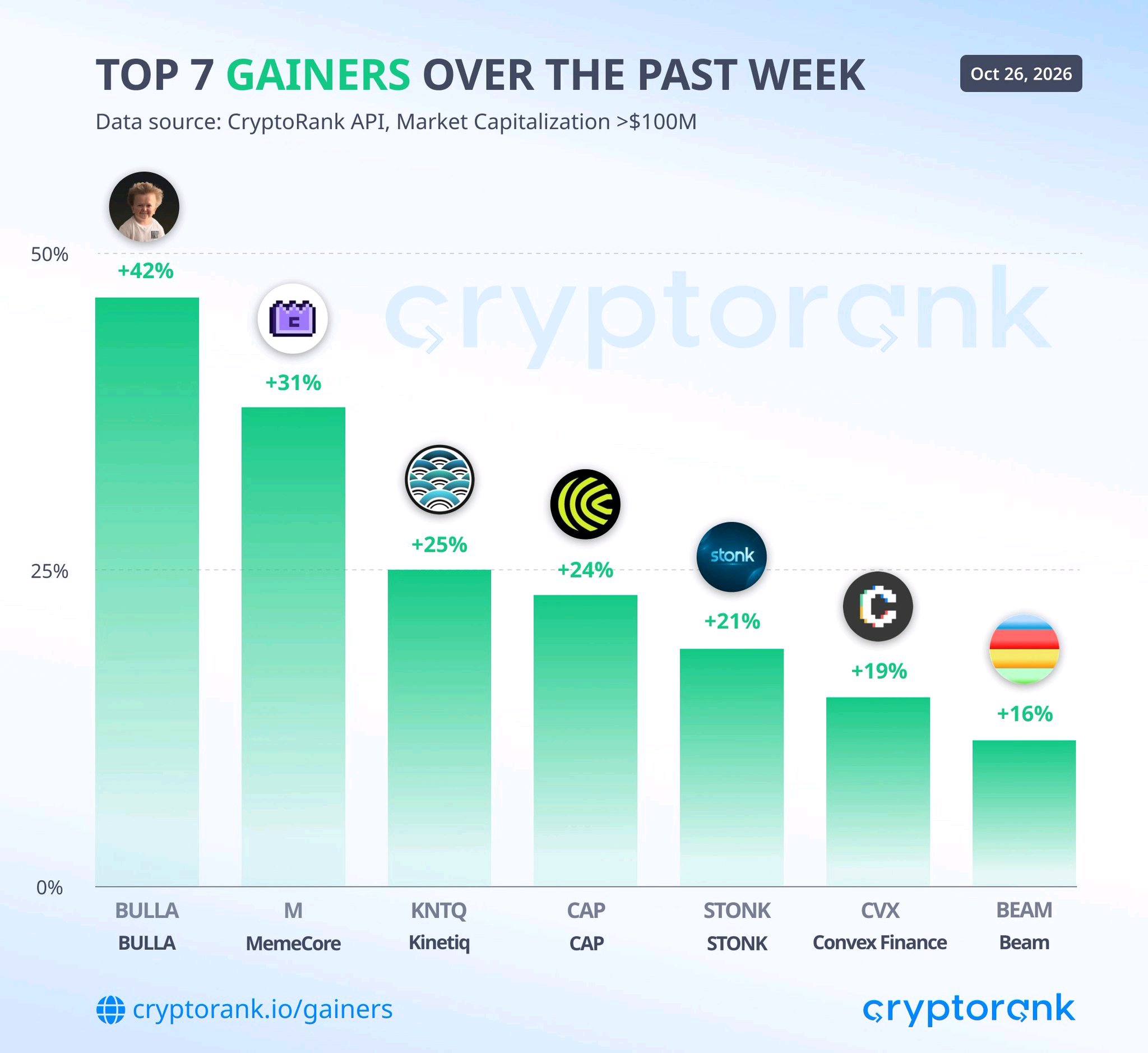
Weekly Market Pulse: Memecoins Dominate as BULLA and $M Lead the Charge (+42%) Fellow traders, let’s cut through the noise and look at the data. The past week has given us a clear insight into current market sentiment: risk appetite is high, and capital is rotating aggressively into high-beta plays. According to the latest data from CryptoRank, the top gainers list is heavily skewed toward memecoins and niche DeFi infrastructure. Here is my breakdown of the Top 7 performers and what the price action tells us about the current market structure. 1. The Memecoin Mania: $BULLA & $M Leading the pack is $BULLA (+42%) and MemeCore ($M) at +31%. This isn't just random noise; it’s a signal that retail liquidity is back on the offensive. When we see gains exceeding 40% in a single week for memecoins with >$100M market caps, it usually indicates a "greed" phase where traders are chasing momentum over fundamentals. · Trader’s Take: While tempting, entering $BULLA at +42% is chasing the dragon. If you are trading these, wait for a retracement to key support levels (like the 20-day EMA) before sizing in. $M's +31% suggests a stronger consolidation narrative might be forming—keep an eye on volume to see if this is a breakout or a bull trap. 2. The DeFi Alpha: $KNTQ The standout performer in the utility sector is Kinetiq ($KNTQ) at +25%. In a sea of memecoins, KNTQ’s performance stands out. This suggests that yield-bearing assets and liquid staking derivatives are gaining traction again. DeFi blue chips are moving, which is often a precursor to a broader altcoin season. · Trader’s Take: This is a healthier long-term play. If KNTQ is breaking out on high volume, it’s worth looking at the Total Value Locked (TVL) metrics for the protocol to confirm the price action. 3. The Mid-Caps & Revival: $CAP, $STONK, $CVX, & $BEAM · $CAP (+24%) and $STONK (+21%) continue the meme/speculative trend. $STONK's branding appeals to the "degen" crowd, but these are high-risk momentum plays. · $CVX (+19%) is an interesting entry on this list. Convex Finance is a legacy DeFi protocol. Seeing it pump implies a rotation into "value" DeFi plays, potentially fueled by stablecoin yield farming narratives. · $BEAM (+16%) rounds out the list, showing steady accumulation in the gaming sector. My Strategic Outlook: The market is currently rewarding risk. However, as a trader, I am watching the Bitcoin dominance closely. If BTC dominance drops further, expect these altcoins to run harder. Conversely, if BTC takes a breather, these top gainers are the first to get hit with profit-taking. Playbook: · Don't FOMO into the tops. Look for pullbacks. · Watch $KNTQ and $CVX as indicators of whether "real yield" is the next meta. · Secure profits on the memecoins ($BULLA, $M). A +42% week is rare; don't let it turn into a -10% month. Stay sharp, manage your risk, and trade the chart, not the emotion.
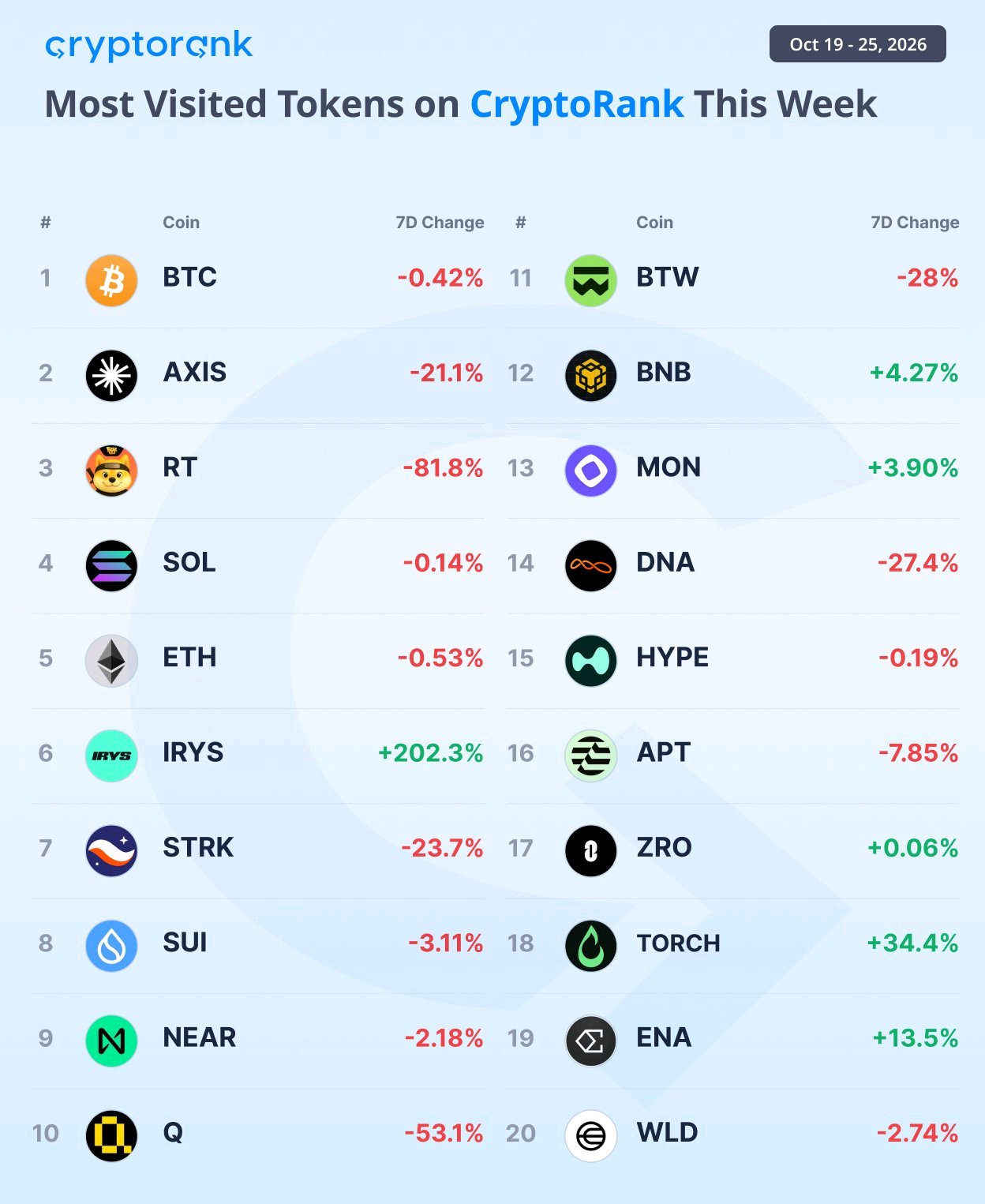
Decoding Retail Sentiment: What CryptoRank’s Top 20 Visited Tokens Tell Us As a trader, I always keep an eye on crowd behavior. Price action is one thing, but attention is the true precursor to liquidity. This week’s CryptoRank data on the most visited tokens provides a fascinating look into the current retail mindset. Let’s break down the data and find the alpha. 📊 1. The "Safe Haven" Search Unsurprisingly, $BTC holds the #1 spot. Despite a flat-to-slightly-red week (-0.42%), Bitcoin remains the undisputed center of gravity. When retail eyes are on Bitcoin, it usually signals a waiting game—traders are looking for market direction before deploying capital into riskier altcoins. 2. The Retail Hype Magnet: $IRYS The absolute standout this week is $IRYS, sitting at #6 in visits with a staggering +202.3% weekly gain. This is textbook retail FOMO in action. A 200%+ move combined with high search volume screams momentum, but as a trader, I know this is a double-edged sword. If you are playing $IRYS here, tight stop-losses are mandatory. 3. Established Layer 1s Stay Relevant Despite the hype around new movers, we see $SOL (#4) and $ETH (#5) holding strong positions in the top 5 most-visited. This tells me that the market isn't purely degenerate; investors are still heavily monitoring the major L1 battles. 4. Hidden Gems & Strong Performance Looking beyond the top 10, we see $TORCH (+34.4%) and $ENA (+13.5%) making their way onto the list (ranks 18 and 19). These are the green candles in a mostly red chart this week. $ENA's rise is particularly interesting as it shows a continued interest in the synthetic dollar and restaking narratives. 5. The "Culling" of Weak Hands Look at the drawdowns. We have $RT (-81.8%) and $Q (-53.1%) occupying high spots (#3 and #10). Why do people visit a token that's down 80%? To check if they are "going to zero" or if a bounce is coming. Often, high search volume on a crashing token is a sign of capitulation and pain. Unless there's a fundamental catalyst, avoid catching a falling knife here. Trader's Takeaway: The market is currently in a highly selective, momentum-driven phase. The retail crowd is chasing explosive breakouts like $IRYS, while keeping a close eye on $BTC for general market health. · Watch out for: High-volume, high-drawdown tokens like $RT—volume doesn't always mean recovery. · Keep on your radar: $ENA for its steady +13% green candle, which shows organic strength amidst the noise. What are you watching this week? Let me know in the comments! 👇 #Altcoins #CryptoMarket #Trading
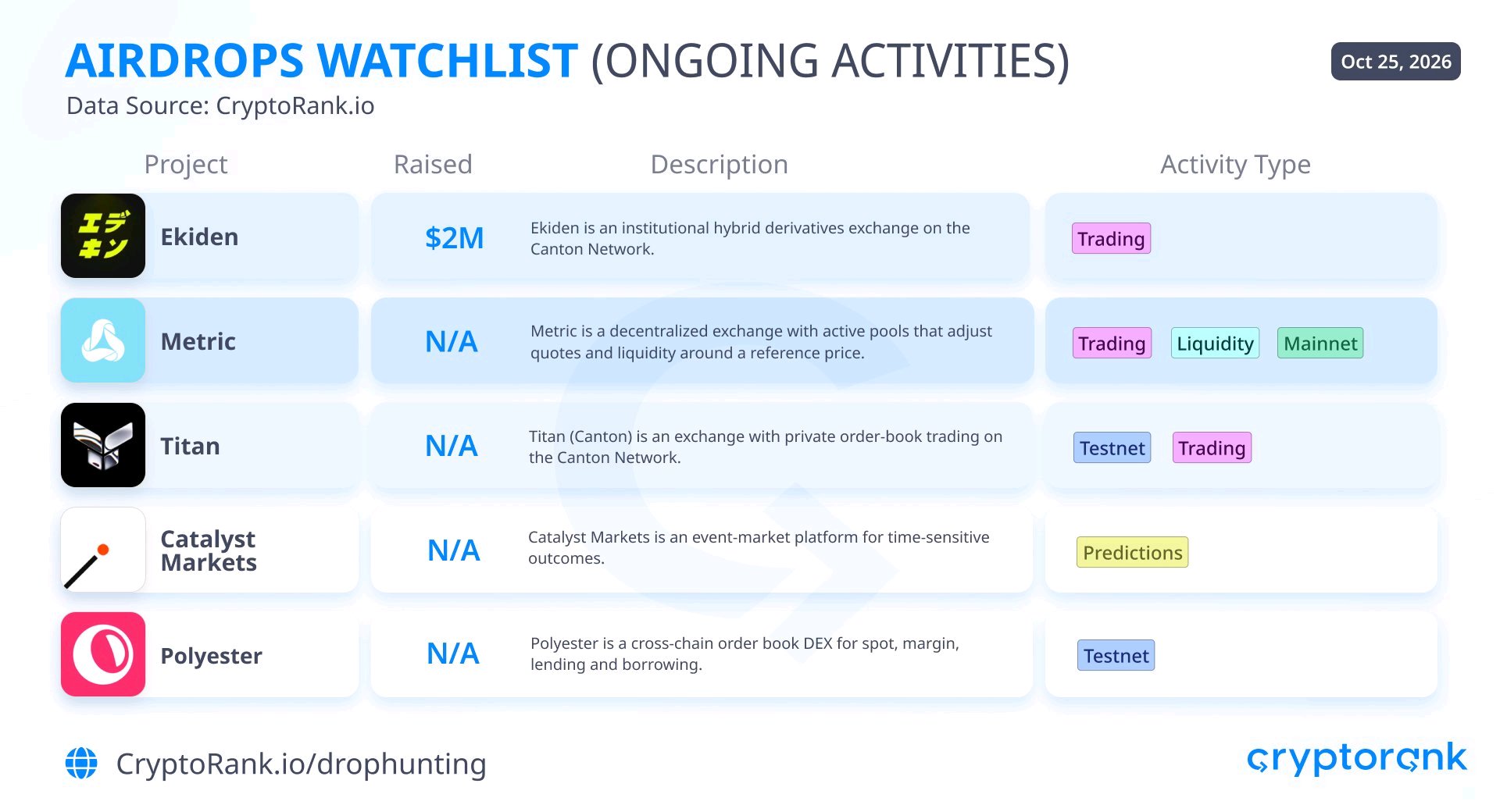
🎯 Airdrop Alpha: 5 Early-Stage Gems to Farm Before the Crowd Arrives Fellow traders, in this market cycle, airdrops remain one of the most lucrative ways to build capital without deploying heavy initial fiat. However, the golden rule of airdrop hunting is simple: be early, or be exit liquidity. Our research team at CryptoRank has flagged 5 projects currently running ongoing activities. These are not your typical zero-utility meme coins; we are looking at solid infrastructure plays across derivatives, DEXs, and prediction markets. Let’s break down the watchlist and how you can position yourselves. 🛠 The Breakdown: 1. Ekiden (@ekidenfi) — Institutional Hybrid Derivatives · Raised: $2M (Backed, not a bare-bones project). · The Play: Built on the Canton Network, Ekiden brings privacy-focused institutional trading. · Activity: Trading. · Trader's Note: Institutional-grade infrastructure usually means massive future volume. Getting in on the ground floor of their trading volume incentives could be highly profitable. 2. Metric (@metricxyz) — Next-Gen DEX · The Play: A decentralized exchange featuring active pools that dynamically adjust quotes and liquidity around a reference price. This is advanced AMM tech. · Activity: Trading, Liquidity Provision, Mainnet. · Trader's Note: Providing liquidity here does double duty—you earn swap fees while farming potential points. Since it's on Mainnet, gas fees are real, so manage your capital efficiently. 3. Titan (@TitanExchange_) — Private Order-Book Trading · The Play: Another Canton Network project. A DEX utilizing a private order-book. · Activity: Testnet, Trading. · Trader's Note: Since it’s still on Testnet, your cost of entry is literally zero. Interact with the testnet, test the order-book mechanics, and secure your spot on the eventual mainnet whitelist. 4. Catalyst Markets (@CatalystMkts_) — Event Prediction Platform · The Play: A platform for time-sensitive event markets (similar to Polymarket). · Activity: Predictions. · Trader's Note: Prediction markets are heating up massively. Engaging in early predictions is a great way to speculate on real-world events while farming a potential token. 5. Polyester (@Polyester) — Cross-Chain Order-Book DEX · The Play: A comprehensive cross-chain DEX offering spot, margin, lending, and borrowing. · Activity: Testnet. · Trader's Note: Multi-chain order books are a complex beast to build. Help them stress-test the protocol on Testnet now, and you'll likely be rewarded when they launch. 📈 The Trader's Strategy: Do not spread yourself too thin. Airdrop farming requires consistency. 1. Focus on Cost-Efficiency: Start with the Testnet projects (Titan & Polyester) to build your on-chain footprint for free. 2. Capital Allocation: For Mainnet plays (Metric, Ekiden), allocate a specific portion of your portfolio for liquidity and trading volume. Use low-slippage pairs. 3. Diversify: Don't just trade; use the actual products (place predictions on Catalyst, test order books on Titan). Anti-Sybil algorithms are getting smarter—real usage is key. The market is quiet right now, which is the perfect time to build your footprint. Don't wait for the TVL to spike and the influencers to shill it. Get in, execute your tasks, and wait for the liquidity drop. #Airdrop #Crypto #DeFi
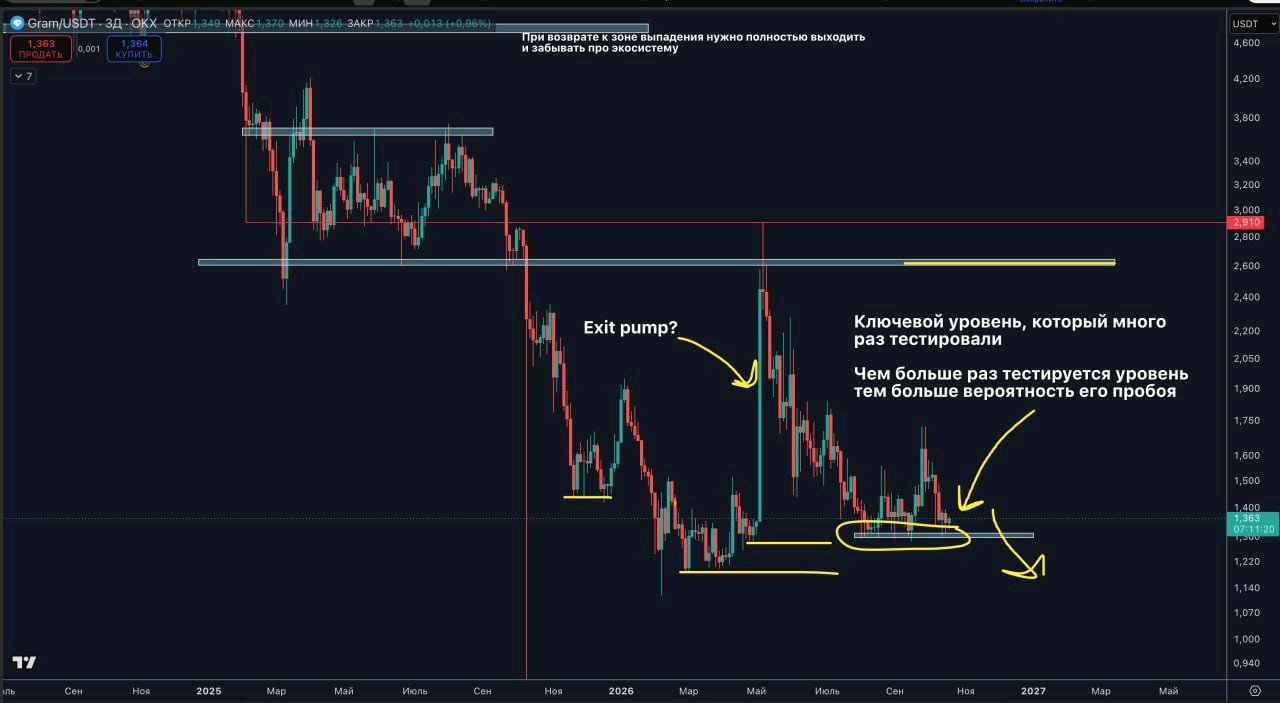
TON Reorganization: Failed Promise or Calculated Trap? 📉 As an experienced trader, I’ve learned one golden rule: never trade on roadmaps, trade on fundamentals and price action. Six months ago, Pavel Durov unveiled an ambitious roadmap for TON, promising fundamental network changes. But looking at the current state of the ecosystem and the chart, we need to ask the hard question: Did the reorganization actually fail? Let’s break down the reality behind the hype. 1. The Revenue Reality Check 💰 For a project with a market cap hovering around $3.8 billion, the network's daily revenue from fees is a joke. TON is currently generating only $2,000–$3,000 per day. This is negligible for a top-tier L1 and shows a lack of real on-chain economic activity. 2. The "Inflation & Unlock" Death Spiral 🔓 The second major red flag is tokenomics. There is constant selling pressure from inflation and investor unlocks. New supply keeps hitting the market, and there is simply no organic demand to absorb it. The market had high hopes for the new internal wallet, but it turned out to be a "swap of a needle for soap"—just another tool nobody uses. 3. Price Action Confirms the Weakness 📊 Let’s look at the chart (see attached). The recent price movement was nothing more than an "Exit Pump"—a bounce after a dump designed to trap late buyers. · Key Resistance: We are currently testing a critical level that has been repeatedly rejected. The more a level is tested, the higher the probability of a breakout (often in the direction of the prevailing trend, which is down). · The Structure: We see a clear downtrend with lower highs and lower lows. The attempt to pump the price on news failed because, fundamentally, nothing changed. 4. Ecosystem Toxicity ☣️ The blockchain is mainly used just for the Fragment market and gifts, but even that hype is fading. TON has essentially become a "machine for attracting investor money." They lure you in with discounts and promises of major updates, but as soon as unlocks occur, the price collapses because there are no fundamental improvements to support it. My Verdict: The ecosystem continues to look toxic. The chart confirms there is no real strength or interest here. Until we see actual revenue growth and a break above key resistance, TON remains a "sell the rally" asset. Stay sharp, manage your risk, and don't become exit liquidity. #TON #Crypto #Trading
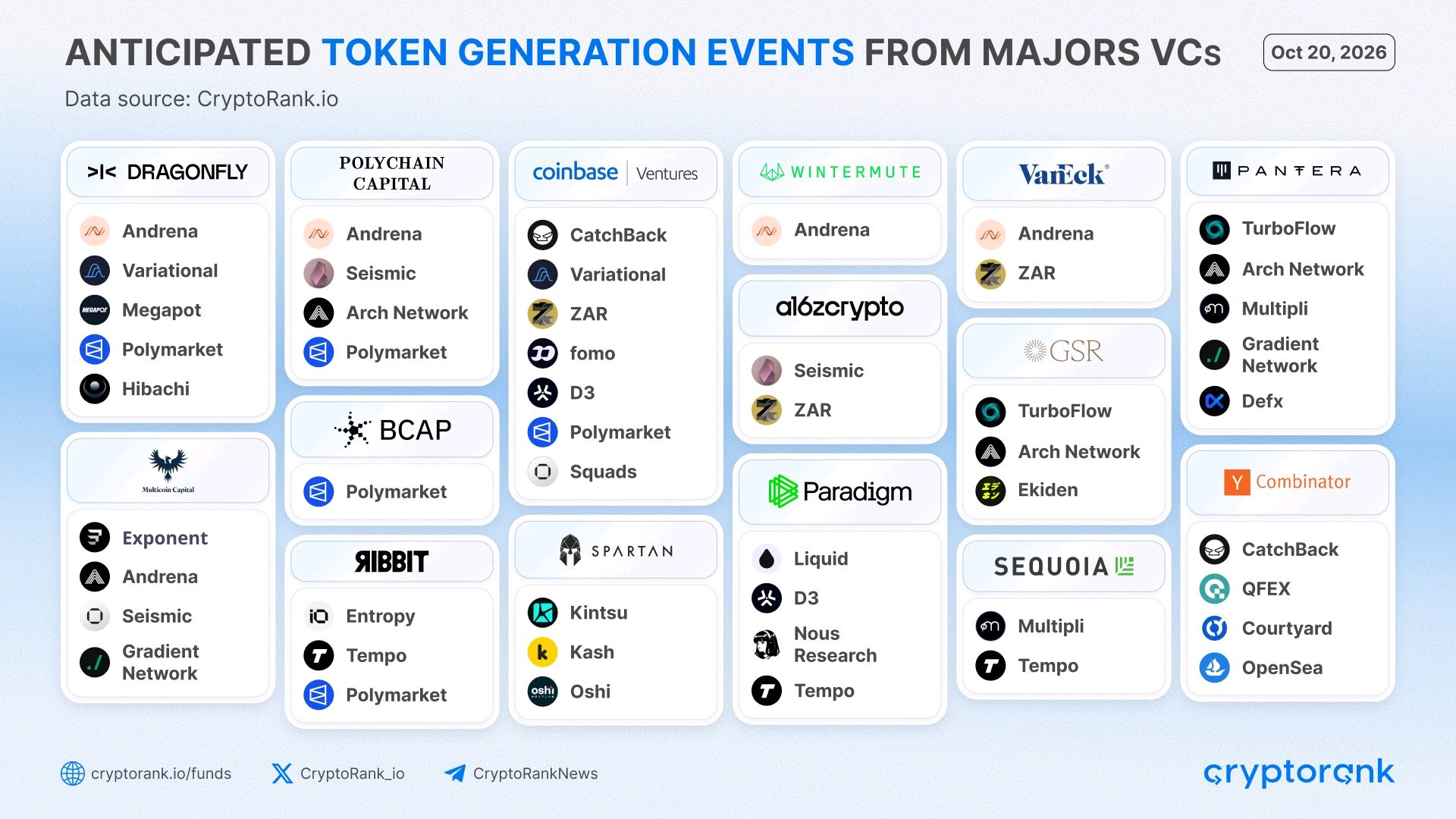
⚡️ Upcoming Crypto TGEs: 6 Major VCs and the Projects to Watch in 2026 Venture capital is building the next generation of crypto projects. But which ones could become the next major token launches? In Q3 2026, crypto companies completed 127 funding rounds, raising $2.62 billion in disclosed capital. Despite changing market conditions, venture funding continues to support the development of new protocols, infrastructure, DeFi platforms, and prediction markets. For crypto investors, this creates an important research opportunity: identifying promising projects before they launch their native tokens. Our latest overview, based on CryptoRank data dated October 20, 2026, highlights projects that have not yet launched their own tokens and are backed by some of the industry's major venture capital funds. 🔎 Projects Worth Adding to Your Watchlist 1. Dragonfly Capital - Andrena - Variational - Megapot - Polymarket - Hibachi 2. Polychain Capital - Andrena - Seismic - Arch Network - Polymarket 3. Coinbase Ventures - CatchBack - Variational - ZAR - fomo - D3 - Polymarket - Squads 4. Wintermute Ventures - Andrena 5. Pantera Capital - TurboFlow - Arch Network - Multipli - Gradient Network - Defx 6. Other Major Investors The infographic also identifies projects associated with Multicoin Capital, BCAP, Spartan, a16z crypto, Paradigm, VanEck, GSR, Sequoia, Y Combinator, and 1RBIT. Notable names appearing across these investor portfolios include Seismic, ZAR, Tempo, D3, Arch Network, Gradient Network, and Multipli. This is a research watchlist, not confirmation that any particular project will launch a token or distribute an airdrop. Funding relationships and token plans should be independently verified. 📊 Why VC Backing Matters 1. Capital can support long-term development Well-funded projects may have more resources for engineering, security audits, ecosystem development, and user acquisition. However, funding alone does not guarantee product-market fit or token value. 2. Repeated appearances across funds attract attention Projects associated with multiple prominent investors can be worth investigating more closely. For example, Andrena appears in several investor columns, while Polymarket is listed across multiple major funds. This overlap can indicate strong institutional interest, but it is not a reliable standalone signal for future token performance. 3. Early participation may create opportunities Some projects reward genuine early users through points, incentives, or token distributions. Others may never launch a token, or their rewards may be limited. The key is to identify projects where meaningful product usage is possible without relying entirely on speculative expectations. 🧠 How to Research Potential TGEs Before committing time or capital, evaluate each project using five criteria: - Token confirmation: Has the team officially announced a token, TGE, or distribution mechanism? - Funding quality: Who invested, and is the funding information verifiable? - Product traction: Are active users, transaction volumes, or ecosystem growth increasing? - Participation requirements: Are there genuine usage opportunities, and what are the costs? - Tokenomics and unlocks: What could the initial circulating supply, investor allocations, and vesting schedule mean for post-launch price action? A major VC name can help identify a project, but it cannot replace fundamental research. ⚠️ The Hidden Risk: A TGE Does Not Guarantee Profit One of the most common mistakes in crypto is assuming that a heavily funded project will automatically produce a valuable token. Even successful projects can launch at aggressive valuations, face substantial unlock pressure, or struggle to sustain demand after initial hype fades. There is also a difference between receiving an airdrop and generating a profit. Transaction fees, time spent, capital requirements, eligibility rules, and token liquidity all matter. Avoid paying for speculative points farming or interacting with unofficial airdrop links simply because a project appears on a VC-backed list. 🎯 My Take The $2.62 billion raised across 127 funding rounds in Q3 2026 suggests that the pipeline of emerging crypto projects remains active. For investors and airdrop hunters, the best approach is to build a structured watchlist, prioritize projects with real products and measurable traction, and monitor official announcements rather than treating every unfunded token opportunity as a guaranteed future launch. Smart positioning starts with research, not FOMO. Which project on this list do you think has the strongest potential for a future TGE?
The Alpha Calendar: Navigating Upcoming TGEs, Listings, and Mainnet Launches Fellow traders, in this market, information is the ultimate edge. While retail gets distracted by short-term volatility, smart money is positioning itself ahead of major supply shocks and fundamental catalysts. Looking at the latest institutional calendar, the next few weeks are packed with high-impact events. We are seeing a dense cluster of Token Generation Events (TGEs) and Mainnet launches that will inevitably dictate liquidity flows and volatility across the mid-cap and small-cap sectors. Here is my tactical breakdown of the upcoming catalysts you need on your radar: 🔴 The Immediate Catalysts (Oct 20 - Oct 21) · FABLES (Oct 20): A straight-up Token Release. Expect immediate sell-side pressure if the initial float is high. Watch the order book depth on listing day. · FHENIX (Oct 21): Mainnet Release. This is a fundamental milestone. If the tech delivers, we could see a strong narrative-driven pump. Keep an eye on Total Value Locked (TVL) post-launch. · AERO (Oct 21): Product Release. As a major Base ecosystem player, any product update here could trigger momentum for the broader Layer-2 narrative. 🟡 Mid-Term Plays (November) · KNTQ (Nov 9): Elysium Mainnet. Mainnet launches are notorious for "sell the news" events if the hype is overly baked in. Trade the announcement, but manage your risk around the actual event. 🔵 The "October & Q4" Liquidity Flood The calendar is absolutely dominated by Token Releases (RITUAL, PULT, RSGP, AXIS in October; INFI, JUMP, APYX, PREDICT, STRN, TENEO, CT, VAR, EXT in Q4). Trader's Strategy for TGEs: With this much new supply hitting the market, liquidity is going to be fragmented. Do not blindly ape into every TGE. 1. Check the Unlock Schedule: Are VCs dumping? Is the initial circulating supply low? 2. Narrative Check: Focus on sectors with active rotation (e.g., AI, RWA, L2s). 3. Wait for the Dust to Settle: Often, the best entry for a new token is after the initial listing day hype fades and a price discovery floor is established. Stay sharp, manage your risk, and don't let these events catch you off guard. Which of these events are you trading? Let me know in the comments. 👇 #Crypto #TGE #Trading

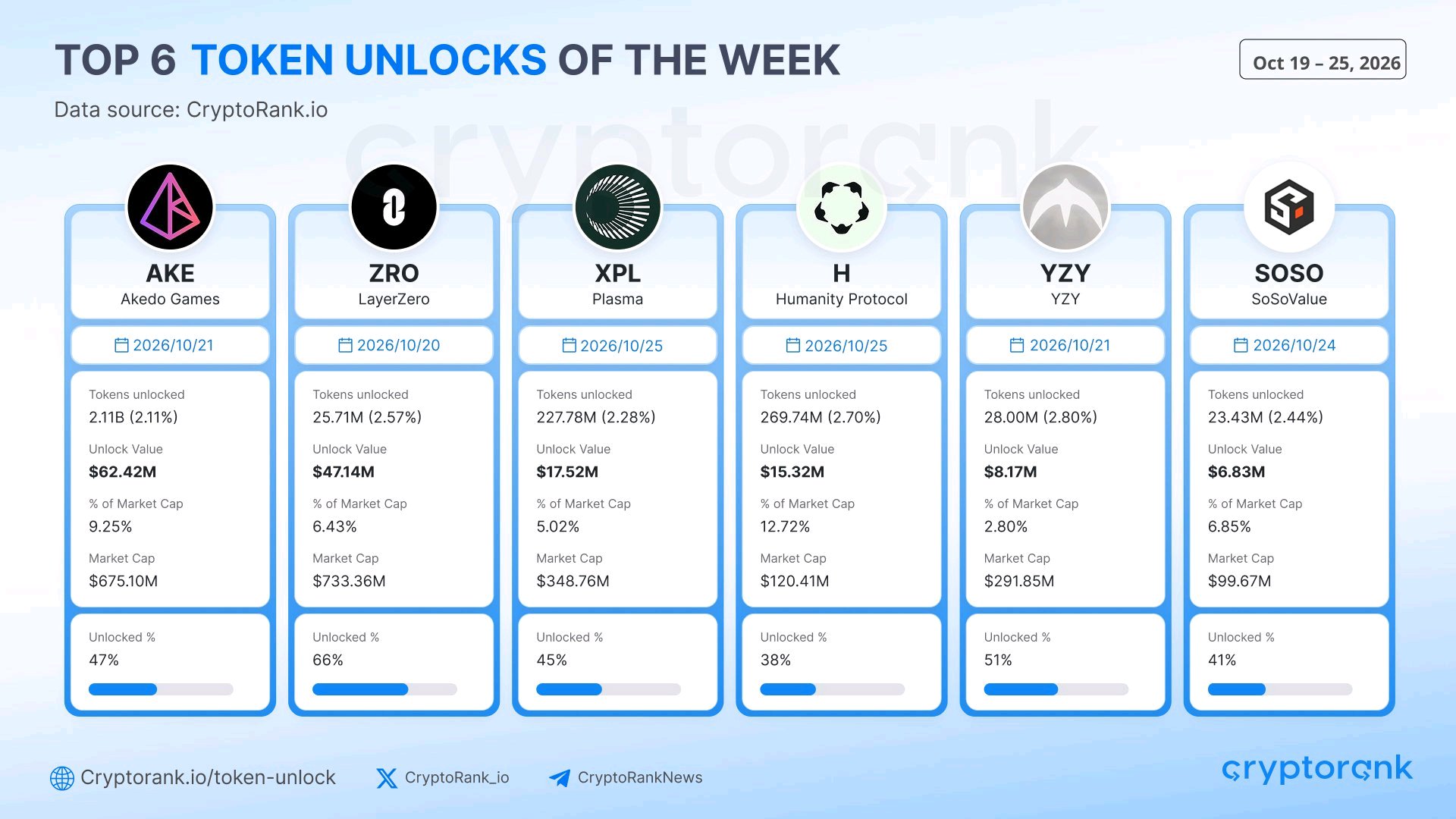
⚠️ Weekly Unlock Radar: Navigating $142M+ in Token Dilution (Oct 19-25) As a trader, I always say that price action is only half the battle. The other half? Tokenomics and supply dynamics. If you are trading blindly without checking the unlock schedule, you are playing poker with your cards face up. Looking at the data from CryptoRank for the upcoming week (October 19 – 25), we have a significant amount of supply hitting the market. Over $142 million in combined unlock value is scheduled. Let’s break down the top 6 unlocks and analyze how a smart trader should position themselves. 🧠📉 🥇 1. $AKE (Akedo Games) — The Heavyweight · Unlock Date: Oct 21 · Unlock Value: $62.42M (2.11B Tokens) · % of Market Cap: 9.25% · Trader's Take: This is the biggest red flag of the week. $AKE is releasing over 9% of its market cap in one go. While the total unlocked supply is 47%, a $62M injection into a $675M MC is highly dilutive. Expect heavy selling pressure. If you are holding spot, consider taking some risk off the table or hedging. Do not buy the dip blindly on unlock day. 🥈 2. $ZRO (LayerZero) — The Liquidity Test · Unlock Date: Oct 20 · Unlock Value: $47.14M (25.71M Tokens) · % of Market Cap: 6.43% · Trader's Take: LayerZero is a massive project, but a $47M unlock relative to a $733M market cap is no joke. The token is already 66% unlocked, meaning the runway is getting shorter, but the immediate supply shock is real. Watch for volatility leading up to Oct 20. 🥉 3. $H (Humanity Protocol) — The High Dilution Alert 🚨 · Unlock Date: Oct 25 · Unlock Value: $15.32M (269.74M Tokens) · % of Market Cap: 12.72% (!) · Trader's Take: This is the most dangerous profile on the list. It’s not the largest dollar amount, but unlocking 12.72% of your market cap in a single day is massive dilution. With only 38% of tokens unlocked so far, $H is in a high-inflation phase. Extreme caution advised. 4. $XPL (Plasma) — The Steady Release · Unlock Date: Oct 25 · Unlock Value: $17.52M · % of Market Cap: 5.02% · Trader's Take: A moderate unlock. 5% of MC is manageable, especially for a token that still has 55% of its supply locked. Keep an eye on the order book on Oct 25, but this isn't a "panic sell" event. 5 & 6. $YZY & $SOSO — The Minor Players · $YZY: $8.17M unlock (2.80% of MC) on Oct 21. · $SOSO: $6.83M unlock (6.85% of MC) on Oct 24. · Trader's Take: These are lower-impact unlocks. For $SOSO, 6.85% is moderate, but given its ~$100M market cap, it doesn't take much volume to push the price around. 💡 How to Trade Unlock Weeks (The Veteran Playbook): 1. Front-Run the Fear: Markets often price in unlocks before they happen. If a token is pumping into an unlock, it's usually a liquidity trap. 2. Watch the 48-Hour Window: The actual volatility usually happens 24-48 hours prior and immediately after the tokens go live. 3. Don't Catch a Falling Knife: Wait for the initial panic selling to subside and for a solid support level to form before entering. 4. Check Vesting Schedules: Always verify who is getting these tokens. If it's VCs or early investors, expect profit-taking. If it's community rewards, the sell pressure might be softer. 🔥 Final Thought: Unlocks aren't always bearish—a strong project with good narratives can absorb the supply and use the liquidity to pump. However, as traders, we must respect the supply mechanics. Which token are you watching closely this week? Are you fading the unlocks or looking to buy the fear? Drop your charts below! 👇📊 #Crypto #TokenUnlocks $ZRO $AKE
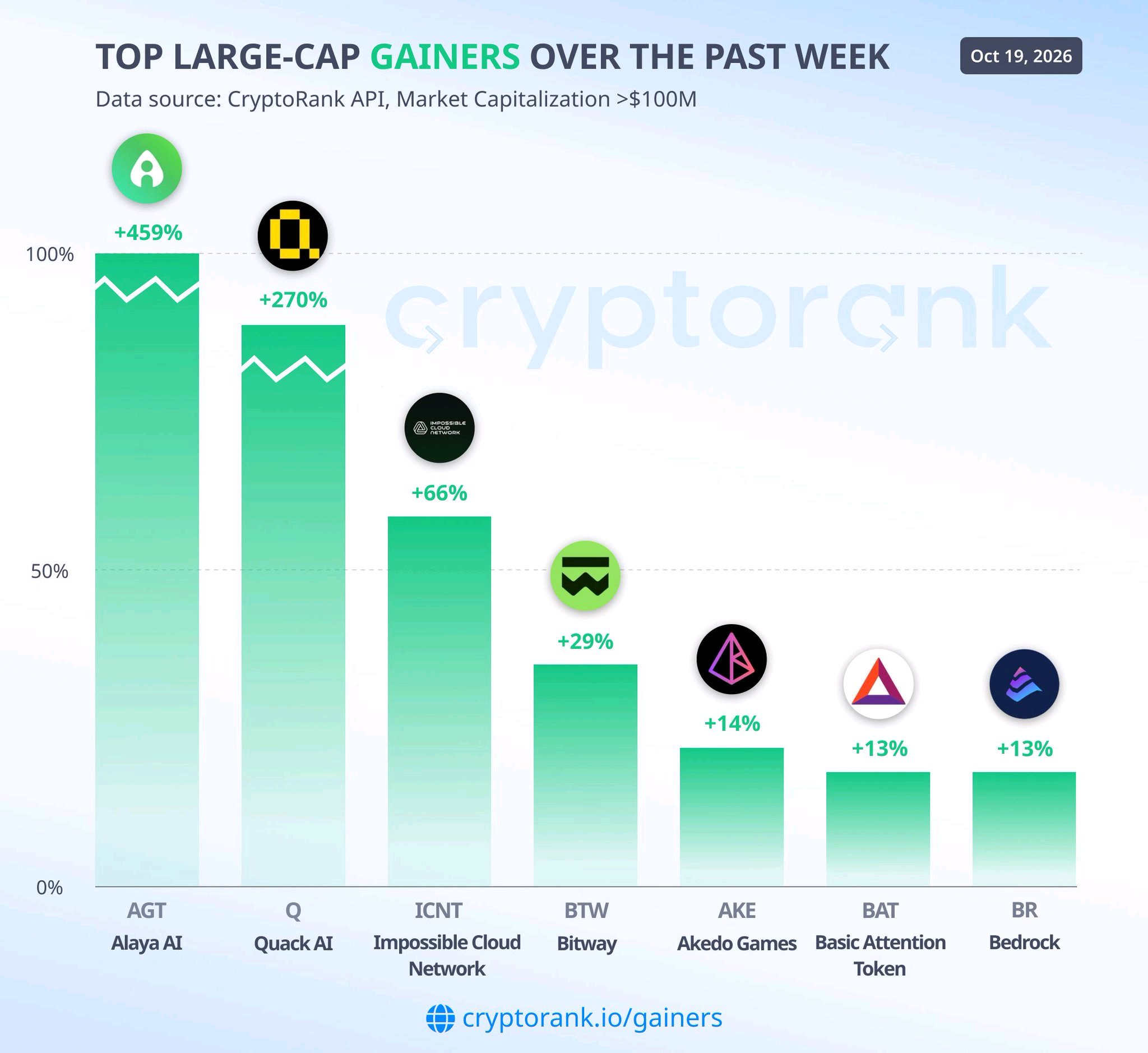
AI Season Confirmed? $AGT & $Q Lead Explosive Large-Cap Rally The past week has delivered a clear message to the market: Artificial Intelligence (AI) is no longer just a narrative; it’s where the liquidity is flowing. According to Cryptorank data, the top large-cap gainers (Market Cap >$100M) are dominated by AI infrastructure and data protocols. Here is a seasoned trader’s breakdown of the top performers and what we can expect next. The Top Performers: AI is Eating the Market The data speaks for itself. AI tokens swept the podium, claiming the top three spots: · $AGT (Alaya AI): +459% – An absolute parabolic move. This kind of explosive growth signals a massive surge in speculative volume and narrative strength. · $Q (Quack AI): +270% – Showing immense strength, nearly tripling in value. This confirms that the market is actively hunting for AI alpha. · $ICNT (Impossible Cloud Network): +66% – A solid, sustainable gain for a decentralized cloud infrastructure play. This isn't just a meme pump; it's utility-driven. The "Second Tier" & Alt-Rotation While AI steals the spotlight, we are seeing healthy rotation into other sectors: · $BTW (Bitway): +29% – A steady climb, indicating capital is still flowing into established infrastructure projects. · $AKE (Akedo Games) +14%, $BAT (Basic Attention Token) +13%, $BR (Bedrock) +13% – These double-digit gains show a broadening market. When mid-caps like $BAT start waking up, it often precedes a wider altcoin season. 📉 Trader’s Takeaway & Strategy 1. The Narrative is King: The market is heavily rewarding the AI sector. If you aren't holding AI-related assets in this market cycle, you are missing the highest beta. 2. Beware of the FOMO: $AGT’s +459% weekly move is incredible, but entering now carries high risk of a pullback. Look for consolidation patterns or use conservative stop-losses. 3. Look for Diamonds in the Rough: Keep an eye on the lower caps that are mirroring the price action of $AGT and $Q. The smart money rotates from the majors to the small caps next. Conclusion The dominance of AI tokens confirms a risk-on sentiment. Are we looking at the start of a full-blown AI season? Share your thoughts below. #Crypto #AI #Binance #Altcoins #Trading #AGT
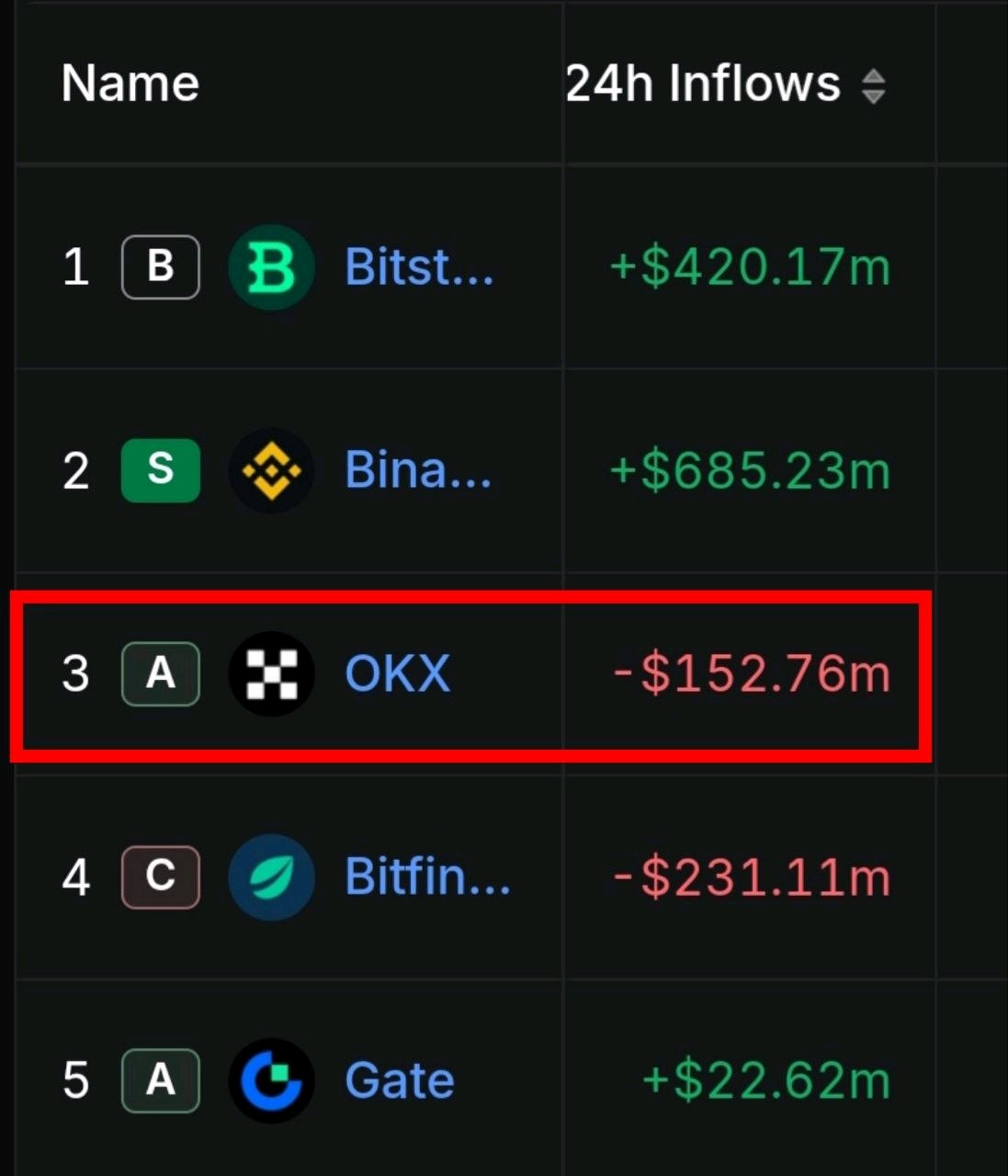
OKX Sees $152M Outflow: Healthy Rotation or Warning Sign? Fellow traders, let's look at the latest data from DefiLlama regarding the top exchanges. The spotlight is on OKX, which recorded a net outflow of over $152 million in the last 24 hours, landing in the negative territory alongside Bitfinex (-$231M), while Binance and Bitstamp remain net positive. Here is my objective breakdown of the situation: 1. Context is Key A single-day outflow of $152M is significant, but in the context of OKX's massive reserve size, it is not a "bank run" scenario. Large-scale movements often reflect institutional rebalancing, market makers moving liquidity to other venues, or users moving assets to cold storage for security. 2. The "Why" Matters We need to distinguish between retail FUD and whale behavior. If this is a one-off withdrawal by a few large holders (whales), it’s noise. However, if this turns into a multi-day trend, we must treat it as a potential liquidity drain. Rising yields in DeFi or a shift in market sentiment could drive users to self-custody. 3. Competitive Landscape Notice that Binance (+$685M) is seeing massive inflows while OKX sees outflows. This might suggest a rotation of capital towards the market leader, especially during periods of high volatility or regulatory uncertainty. My Trading Take: Do not panic just yet. One day does not define a trend. I will be watching the 7-day net flow average. If the negative trend continues, expect potential volatility and wider spreads on OKX. For now, this looks like a standard market rotation, but caution is advised. Stay data-driven, not emotional.
Decoding Retail FOMO: A Trader's Analysis of CryptoRank’s Top Searched Tokens Fellow traders, when we look at the "Most Searched" lists, we aren't just looking at curiosity—we are looking at liquidity traps, narrative shifts, and the next wave of retail volume. Let’s break down this week's CryptoRank data (Oct 12-18) with a cold, analytical eye. 1. The Starknet ($STRK) Narrative Shift Taking the #1 search spot is $STRK, despite a brutal -36.2% drawdown on the 7D chart. Why the massive interest? The team just announced plans to pivot toward becoming an independent post-quantum L1. As traders, we know this is a classic "buy the rumor, sell the news" or a "catch the falling knife" scenario. Retail is clearly trying to figure out if this fundamental pivot is a genuine turnaround or just a narrative band-aid over a heavy chart. High search volume + heavy price drop = extreme volatility. Keep this on your watchlist, but wait for price stabilization before acting. 2. The Momentum Plays: $DNA & $BTW The real action this week is in the smaller caps. $DNA is up a staggering +65.5%, and $BTW is following closely at +59.2%. Both are sitting at #12 and #2 on the search list respectively. This is textbook retail FOMO. Traders are chasing green candles, trying to catch the next parabolic move. If you are trading these, you need strict risk management—they are highly volatile, and catching the top can be catastrophic. 3. The "Steady Eddy" Majors & Infra While meme/shitcoins pump, we see structural plays like $TIA (+14.9%) and $EIGEN (+4.66%) making the list. This suggests that smart money is still eyeing modular blockchains and restaking narratives despite the overall market chop. The Market Context (Reality Check) Look at the 7D change column. It’s mostly red. Even $BTC (-1.76%) and top L2s like $ARB (-2.42%), $OP (-5.82%), and $SUI (-11.9%) are bleeding. The fact that the vast majority of the top 20 searched tokens are in the red tells us one thing: retail is looking for bargains or exit liquidity. They are searching for bottom formations. Trader's Takeaway: Don't let the search volume dictate your trades. Use it as a sentiment tool. The market is currently driven by narrative-induced volatility ($STRK) and isolated small-cap pumps ($DNA, $BTW). If you are trading, keep your leverage low and your stop-losses tight. The overall market is consolidating. What are you trading this week? Let me know in the comments! 👇

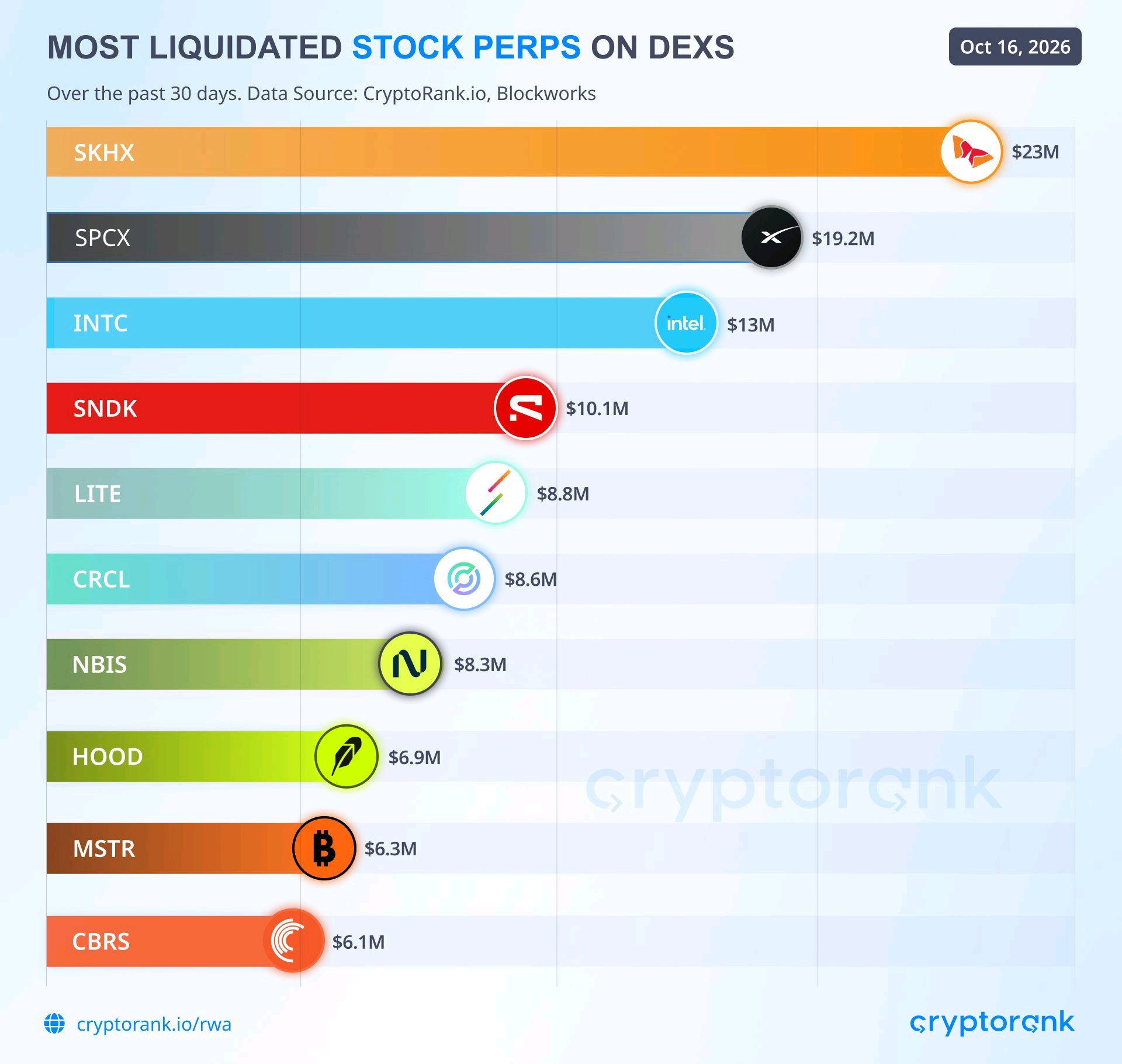
The $110M Wake-Up Call: Why Stock Perps on DEXs Are the New Battleground Fellow traders, if you think the volatility in crypto is wild, you need to look at what’s happening in the tokenized equity sector. The latest data from CryptoRank and Blockworks reveals a massive liquidity event that should be on every serious trader's radar. Over the past 30 days, we’ve witnessed $110.3M in total liquidations across the top 10 stock perpetuals on DEXs. But here’s the kicker: 54% of that carnage happened in the last 7 days alone. This isn't just a minor pullback; this is a leverage flush. Let’s break down the numbers and what they mean for your portfolio. The Liquidation Leaderboard: 1. $SKHX:$23M 2. $SPCX:$19.2M 3. $INTC:$13M 4. $SNDK:$10.1M 5. $LITE:$8.8M The Trader’s Take: The concentration of liquidations in the last week tells me one thing: Late-stage FOMO meets high-leverage degeneracy. When we see names like $INTC and $SNDK sitting alongside crypto-native assets, it signals that the "Real World Asset" (RWA) narrative on DEXs is maturing. However, the infrastructure for these perps is still highly reflexive. A sudden 5% move in the underlying stock during traditional market hours can trigger a cascade of liquidations on-chain that has nothing to do with crypto market sentiment. Why this matters: This $110M figure is a drop in the bucket compared to Binance’s daily volume, but it’s a massive signal. It shows that traders are increasingly looking to DEXs to get 24/7 exposure to traditional equities with crypto-style leverage. My advice: If you are trading stock perps on DEXs, remember that you are playing in a low-liquidity environment compared to CEXs. The wicks are longer, and the liquidations are brutal. The 54% weekly spike suggests that many traders were caught offside by a sharp move. Manage your risk, keep your leverage low, and remember: in the perp game, survival is the only metric that matters. Are you trading these stock perps? Let me know in the comments. 👇 #Crypto #Trading #RWA #DeFi #Binance
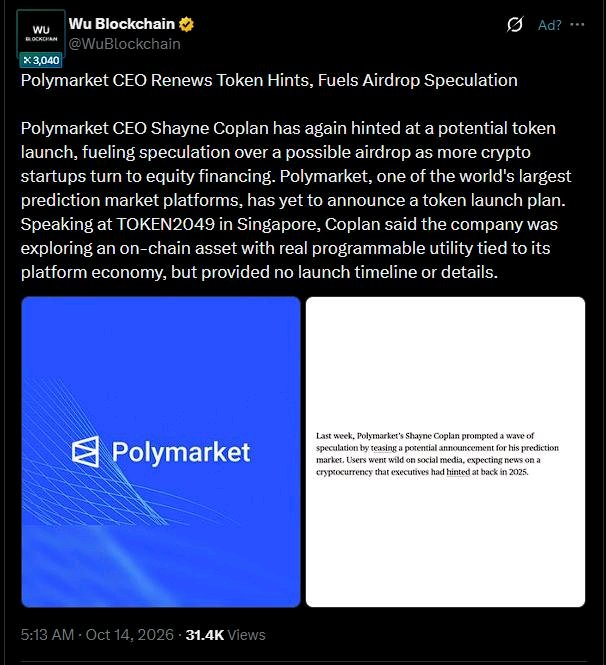
Polymarket: Airdrop or IPO? Why the Token Might Never Come The community has been farming Polymarket for years in anticipation of a long-awaited airdrop, but recent news forces us to seriously reconsider: does the platform even need its own token? Recently, Polymarket CEO Shayne Coplan took the stage at TOKEN2049 again. Instead of a long-awaited tokenomics announcement, we only heard reflections on the prospects of on-chain assets and "real programmable utility." Meanwhile, Bloomberg raises a question that could change everything: the company is discussing a new funding round at a $21 billion valuation and is actively moving toward the institutional market. Why This Matters for Traders A trend is emerging in the market that could bury classic airdrops. Some crypto projects are not just refusing to launch new tokens, but are revising the role of existing ones, offering holders to exchange them for equity in the business. Examples already exist: Across Protocol and Centrifuge are moving to a model where tokens can be exchanged for company shares. For institutions entering the project, the traditional equity ownership model is far more understandable and attractive than another complex tokenomics scheme with dubious utility. The Key Question If Polymarket chooses the path of raising capital through equity with IPO prospects, what will users who have traded on the platform for years in hopes of a drop actually get? Spoiler: likely nothing but experience. Of course, for now, this is just speculation. There is no official token announcement or confirmed IPO plans from Polymarket. But if the IPO scenario materializes, the only guaranteed way to get an allocation will be participating in a traditional IPO through brokers (e.g., Kraken) or venture funds (A2DAO), not farming on the platform. Trader's Takeaway: Do not build your strategy solely on expecting an airdrop from Polymarket. Keep an eye on official statements and news about the funding round. If the company goes the IPO route, it will be a tectonic shift for the entire DeFi and prediction markets sector. #Polymarket #Crypto #Airdrop #IPO #Binance
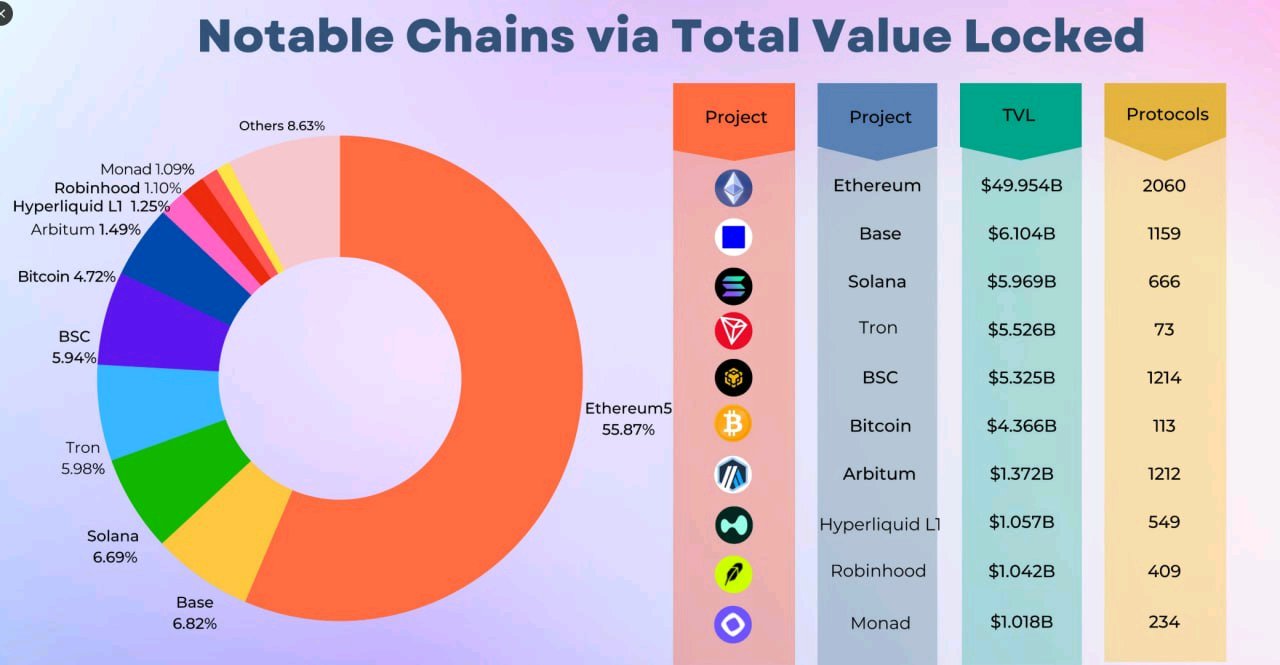
The Battle for Liquidity: Decoding the Latest TVL Landscape In crypto, price action is temporary, but liquidity is permanent. As a trader, I don't just look at green and red candles; I look at where the smart money is parked. The latest Total Value Locked (TVL) data reveals a fascinating narrative about the current state of the market. Let’s dive into the numbers and extract actionable insights. 1. Ethereum's Absolute Dominance (55.87%) With nearly $50 Billion in TVL, Ethereum remains the undisputed king of DeFi. Despite the rise of "Ethereum killers" and the modular narrative, ETH holds over half the market share. For traders, this means ETH remains the primary battleground for deep liquidity, institutional capital, and blue-chip altcoins. It is the safest harbor in the storm. 2. The Rise of Layer 2s: Base & Arbitrum The most important trend here is the cannibalization of mainnet activity by L2s. · Base ($6.1B TVL): Coinbase’s L2 has officially flipped Solana in TVL. This is massive. It signals that retail and on-chain users are migrating to a low-fee, highly integrated ecosystem. Base is no longer just a "hype chain"; it's a liquidity powerhouse. · Arbitrum ($1.37B): While lower in TVL than Base in this specific snapshot, Arbitrum remains the institutional DeFi hub with over 1,200 protocols. It is the backbone of scalable Ethereum. 3. Solana & Tron: The Non-EVM Contenders · Solana ($5.96B): SOL is holding its ground impressively. With 666 active protocols, it proves that the "monolithic" high-speed chain thesis works. Solana is the primary challenger to Ethereum’s throne, acting as the home for high-frequency trading and consumer apps. · Tron ($5.52B): The sleeping giant. Tron consistently ranks top 5 in TVL with only 73 protocols. This extreme efficiency highlights its dominance in stablecoin transfers (USDT) and payments, particularly in emerging markets. 4. The "Others" & Emerging Ecosystems Look at the "Others" slice (8.63%). We see emerging players like Monad ($1.01B) and Robinhood ($1.04B). · Robinhood: Seeing a traditional brokerage like Robinhood with over $1B in TVL is a massive signal of TradFi merging with DeFi. · Hyperliquid L1: With $1.05B TVL, Hyperliquid is proving that a dedicated chain for perpetual trading is a viable business model, directly challenging dYdX and GMX. 🚀 Trader's Takeaway: The market is fragmenting. While Ethereum is the anchor, the growth is happening at the edges—specifically on Base and Solana. If you are farming airdrops or looking for retail volume, focus on Base. If you are looking for deep, stable yield, Ethereum and Arbitrum remain unmatched. Keep your capital where the liquidity is.
🚨 Altseason is losing momentum. Which altcoins are still worth watching? 🧬 $SOL — potential support at $96, recovery target $140 🟠 $ZEC — $1,200 first zone, then $1,000 / $900 / $600 🕸 $NEAR — holding $4 could open the way toward $8–$10 💧 $SUI — a confirmed breakout above $1.50 could change the game No blind buying. Watch support, momentum & confirmation. TAO, LINK, JUP next? 👀 Drop a 👍 #Crypto #Altcoins #Trading

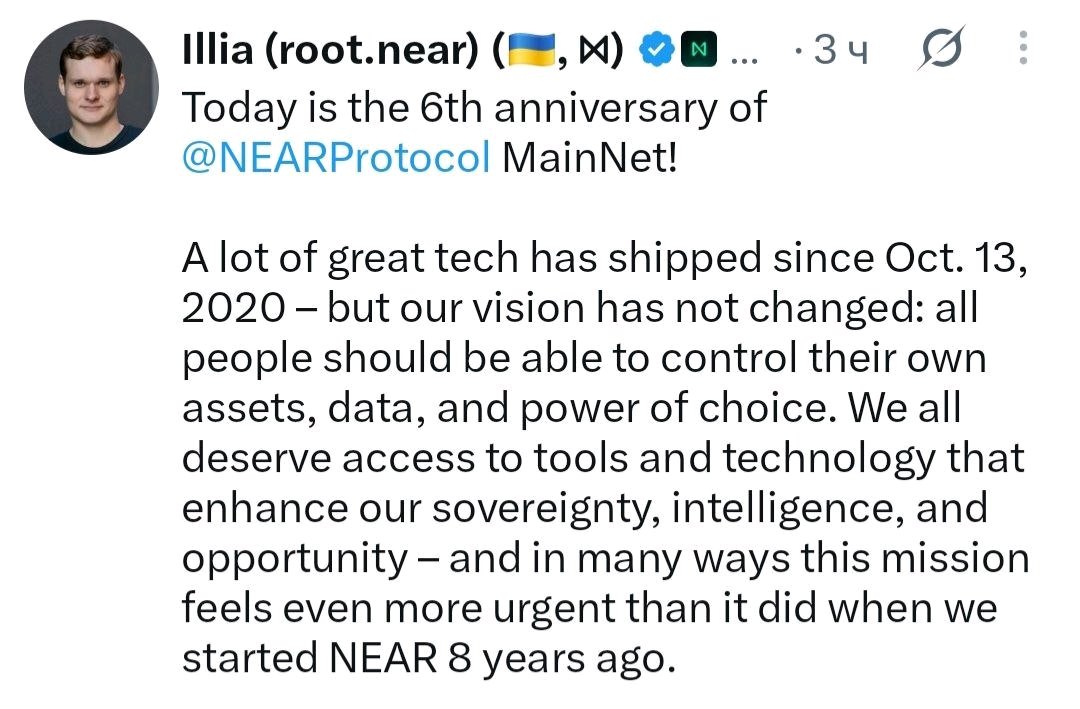
NEAR Protocol's 6th MainNet Anniversary: From L1 Contender to Multi-Chain Intents Powerhouse Six years ago, on October 13, 2020, NEAR Protocol launched its MainNet with a bold vision: empowering users to control their own assets, data, and power of choice. Fast forward to today, and that mission feels more urgent than ever. But as a trader, what catches my eye isn't just the philosophy—it's the massive fundamental shift in the protocol's economics and infrastructure over the past 12 months. Here is my deep dive into why NEAR is quietly positioning itself as one of the most critical infrastructure plays of this cycle. 1. The Intents Explosion (The Real Story) The headline number here is staggering: NEAR Intents processed $34 billion in volume, a 17x YoY increase. This isn't just a narrative; it's real utility. By integrating 15 additional chains (now 35 total), NEAR is effectively becoming a chain abstraction hub. The launch of Confidential Intents ($3B volume, $170M TVL) adds a privacy layer that institutional and retail whales demand. This is where NEAR captures value beyond its own L1. 2. Tokenomics 2.0: The Value Accretion Shift The update to tokenomics is a game-changer for holders. By cutting inflation in half and redirecting Intents fees to generate revenue, NEAR is transitioning from a pure inflationary L1 to a deflationary/utility-driven asset. The launch of House of Stake 2.0 further aligns long-term incentives. This is exactly what traders want to see: a shift from "tech for tech's sake" to "tech that captures value." 3. Tech & Institutional Validation While the tech stack is impressive—1M TPS in public benchmarks, dynamic sharding, and post-quantum security—the institutional adoption is the real cherry on top. The launch of the Bitwise NEAR ETF and the first public treasury company (SVRN) signal that traditional finance is waking up to NEAR's potential. The Trader's Take: NEAR is no longer just a "sharded L1" play. It is evolving into a cross-chain settlement layer with a deflationary economic model and institutional on-ramps. The 6th anniversary isn't just a celebration; it's a fundamental pivot point. With the tokenomics revamp and Intents scaling exponentially, I am watching the $NEAR chart closely for a breakout of its accumulation range. The fundamentals are catching up to the price. #NEAR #Crypto